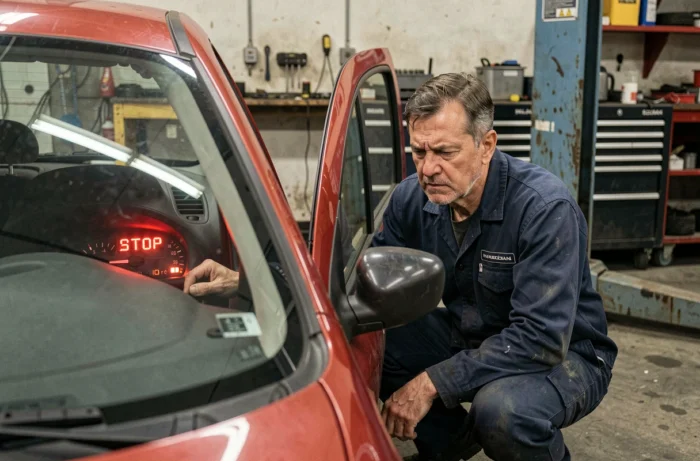
The STOP light on the Clio 3 is a red warning indicator on the dashboard that signals a serious anomaly requiring the vehicle to stop. It does not correspond to a single failure: it is triggered when the control unit detects a critical fault in the braking circuit, lubrication circuit, or cooling system. Understanding which subsystem is involved helps avoid prolonged immobilization or engine damage.
Braking hydraulic circuit and STOP light on Clio 3
On the Clio 3, the STOP light is frequently related to the braking hydraulic circuit. A level sensor, located on the brake fluid reservoir, sends a signal to the control unit as soon as the fluid level drops below the minimum threshold. The drop can result from a leak in a hose, a seized caliper consuming fluid, or simply from very worn brake pads causing the pistons to extend further.
Brake fluid is hygroscopic: it absorbs moisture over time. Brown fluid that hasn’t been bled for more than four years loses its boiling point and can cause vapor lock (formation of gas bubbles in the circuit). This phenomenon does not always trigger the STOP light directly, but it degrades the pressure to the point where the sensor eventually reacts.
For vehicles over ten years old, like most Clio 3s on the road, brake system failures are among the top three causes of nearly half of the re-inspections at technical checks. Cracked hoses, fluid leaks, and unperformed bleeding are the most common reasons.
Consulting the list of dashboard warning lights for Clio 3 helps quickly determine whether the warning is associated with braking or another subsystem.
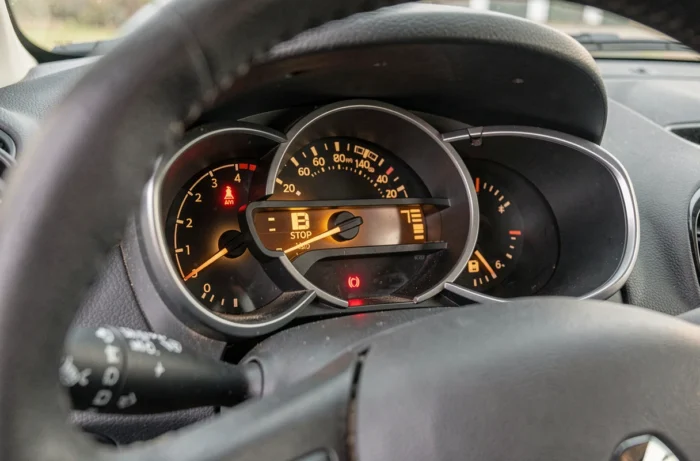
Engine oil pressure: the most destructive STOP light
When the STOP light is accompanied by the symbol of an oil can, the engine is running without sufficient lubrication. On the 1.5 dCi engines that equip a large part of the Clio 3 fleet, the oil pump is driven by the crankshaft. A drop in pressure can result from a low oil level, a clogged oil filter, or a failing pump.
The rule is clear: turn off the engine within seconds of this warning light coming on. Prolonged operation without oil pressure causes metal-to-metal contact on the connecting rod bearings, with a risk of irreversible engine seizure. The cost of replacing an engine block far exceeds that of a tow.
Check the level before any electronic diagnosis
Before connecting an OBD scanner, the first step remains the manual dipstick check. With the engine off for a few minutes, the dipstick should indicate a level between the min and max marks. A correct level with the STOP light on points to a faulty oil pressure sensor or a pump issue, both of which require more advanced tools for diagnosis.
Engine overheating and coolant on Clio 3
The third classic scenario involves the cooling circuit. The STOP light may illuminate alongside the temperature warning (red thermometer). On the Clio 3, recurring causes include a thermostat stuck in the closed position, a radiator fan that no longer activates, or a leak at the thermostat housing.
An overheating engine warps the cylinder head gasket. Repairing a head gasket on a 1.5 dCi involves several days of immobilization and a significant budget. Again, turning off the ignition quickly limits damage.
- Check the expansion tank level when cold: a level below the min mark indicates a leak or abnormal consumption
- Visually inspect the cooling hoses, especially at the connections where the clamps age
- Ensure the electric fan activates when the temperature rises (audible with the hood open, engine running)
OBD diagnostics and recall campaigns: two avenues not to overlook
An OBD reader connected to the diagnostic port (located under the steering wheel, left side on the Clio 3) allows reading the fault codes recorded by the control unit. The STOP light alone, without any other associated warning, may result from a loose connection on a sensor or an electrical issue on the dashboard circuit board, a documented problem with this model.
As of January 1, 2026, a decree stipulates that a vehicle subject to a manufacturer recall deemed “serious” is automatically classified as having a critical failure during technical checks. Its validity is then limited to 24 hours if the recall has not been performed.
In practical terms, if the STOP light on your Clio 3 is related to a defect covered by an uncompleted Renault recall, the vehicle will fail the inspection regardless of the actual condition of the brakes or engine.
Good reflexes in response to the STOP light
- Stop the vehicle as soon as possible, in a safe place, and turn off the engine
- Identify the associated warning (oil can, thermometer, brake symbol) to guide the diagnosis
- Check the levels of brake fluid, engine oil, and coolant before any other intervention
- Consult the maintenance log and the manufacturer’s website to see if a recall campaign is ongoing for your serial number
The STOP light on the Clio 3 covers three distinct mechanical emergencies, and the course of action depends entirely on the accompanying warning. A visual check of the levels takes less than five minutes and is often sufficient to identify the fault. For Clio 3s still in circulation, checking the status of manufacturer recalls has become a full-fledged step since the 2026 regulation.