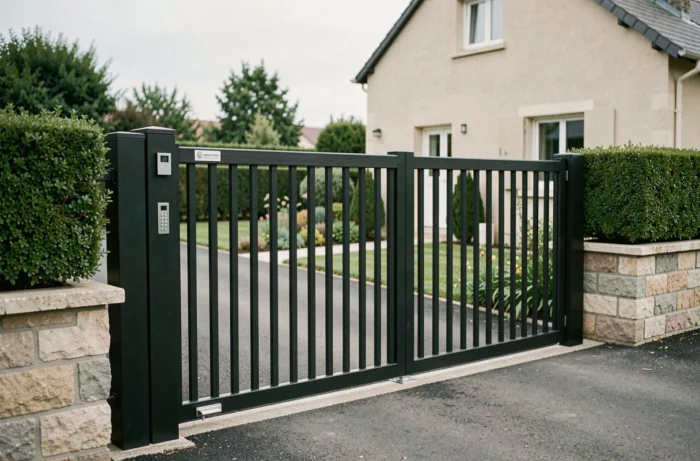
Every day, you pass by your gate several times. To take out the car, pick up a package, let in a neighbor. Opening a full gate every time you walk through can become a burden on daily comfort. This is exactly the problem that a gate with an integrated pedestrian door solves: it combines a wide vehicle access and an independent pedestrian passage in a single structure.
Integrated pedestrian door and EN 13241 standard: what manufacturers don’t always specify
Before discussing aesthetics or comfort, a technical point deserves your attention. The European standard EN 13241 governs the safety of residential gates, whether motorized or not. It imposes specific requirements on mechanical resistance, prevention of pinching risks, and compliance of locking devices.
When a pedestrian door is integrated into the gate leaf, these requirements also apply to it. The closing mechanism of the pedestrian door, the hinges, the gap between the frame and the leaf: everything must limit the risk of pinching, especially for children.
In practical terms, this means that choosing a gate with an integrated pedestrian door that complies with this standard guarantees you a verified level of safety. Always ask the manufacturer or installer for the EN 13241 compliance declaration before signing a quote.
Accessibility for people with reduced mobility of the pedestrian door: minimum width and new constraints
You may have noticed that some pedestrian doors are too narrow to allow a wheelchair or a double stroller to pass? This detail has regulatory consequences in new constructions.
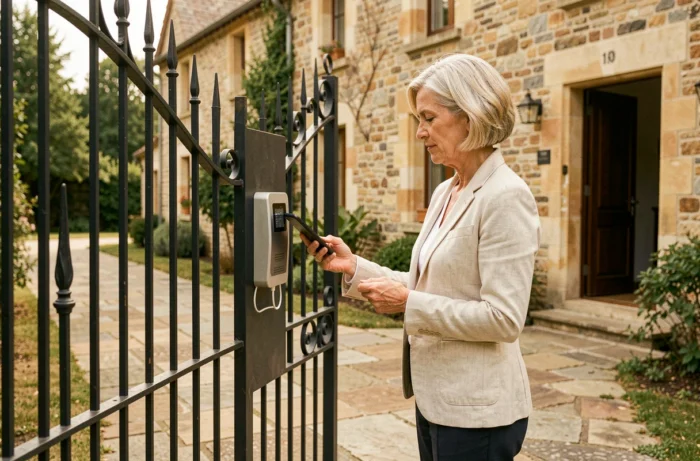
In France, PMR accessibility standards require that the external accesses of a dwelling provide a minimum width of 1.20 meters. For the front door itself, the useful passage must reach about 83 cm. An integrated pedestrian door that is too narrow can therefore pose a compliance issue if your house is new or if you are renovating to meet standards.
The ELAN law strengthens this requirement for new collective buildings: at least 20% of the housing must be fully accessible upon delivery. In individual homes, the logic is the same. Plan for a pedestrian door with at least 90 cm of useful passage if you want to anticipate PMR use or simply facilitate passage with bulky loads.
Swing or sliding gate with pedestrian door: which type to choose based on your terrain
The choice between swing and sliding is not solely a matter of taste. It depends on the configuration of your entrance.
Swing gate with integrated pedestrian door
The pedestrian door is inserted into one of the two leaves, usually the one on the pedestrian side. This solution works well when you have enough space in front of the gate for the leaves to open. The pedestrian door opens independently, inward or outward depending on the installation.
The swing gate remains the most common choice in residential settings, as it adapts to the majority of home entrances. The motorization is attached to each leaf, and the pedestrian door retains its manual operation or can be equipped with an electric strike connected to an intercom.
Sliding gate with integrated pedestrian door
On a sloped terrain or when space is limited, the sliding option makes perfect sense. The pedestrian door is then cut into the sliding panel itself. The advantage: no swing space in front or behind the gate.
The main constraint is the ground rail (or the self-supporting system). The pedestrian door must be able to open without interfering with the sliding mechanism. Ensure that the manufacturer provides for automatic locking of the sliding panel when the pedestrian door is open, to prevent any accidental movement.
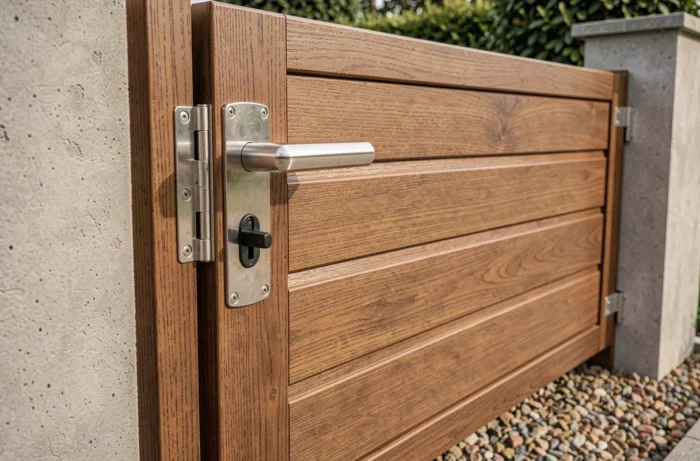
Aluminum, steel, or PVC: which material for a durable gate with pedestrian door
The material determines the durability, maintenance, and visual appeal of the whole. Here are the most common options for this type of installation:
- Aluminum: lightweight, corrosion-resistant, available in a wide range of colors through powder coating. It is the most commonly used material for gates with integrated pedestrian doors, as it allows for precise cuts without weakening the structure.
- Steel: heavier and stiffer, suitable for large dimensions. It requires anti-corrosion treatment (galvanization, epoxy paint) and regular maintenance near the sea or in humid areas.
- Reinforced PVC with aluminum: an economical, lightweight, maintenance-free solution. The rigidity is lower, which limits the width of the gates. Suitable for standard-sized entrances.
For a swing or sliding gate with a pedestrian door, aluminum offers the best compromise between weight, strength, and customization freedom. The choice of finish (matte, satin, textured) allows you to harmonize the gate with the facade of the house.
Visual coherence of the entrance: how the integrated pedestrian door simplifies the design
A separate pedestrian door, placed next to the gate, creates two distinct visual elements. Even if matched, they remain two objects with their own posts, alignments, and proportions.
The integrated pedestrian door eliminates this problem. It is part of the overall design of the gate. The bars, slats, or panels extend seamlessly. The entrance forms a unified whole rather than an assembly.
This visual coherence has a direct effect on the perception of the property. A homogeneous entrance appears neater, more thoughtfully designed. This is a detail that matters if you are considering a resale in the medium term.
The last point to keep in mind is compliance. A well-sized gate with an integrated pedestrian door, compliant with the EN 13241 standard and respecting accessibility widths, saves you from costly adjustments after installation. Take the time to check these two criteria before finalizing your order.