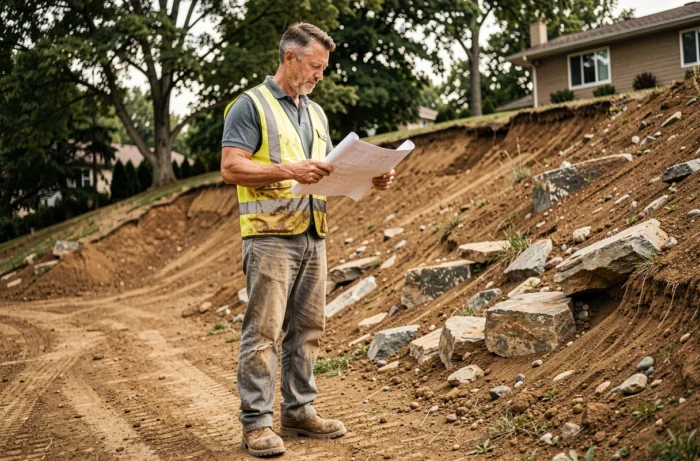
Earthmoving on a sloped terrain involves modifying the natural profile of the soil to create a stable foundation, whether for a house, a pool, or outdoor landscaping. The budget is influenced less by the gross area than by the combination of the slope degree, the geological nature of the soil, and the method chosen for redistributing the earth.
BT02 Index and Recent Trends in Earthmoving Prices
Earthmoving rates are not fixed from year to year. INSEE publishes the BT02 “Earthmoving” index each month, which aggregates variations in labor costs, fuel, equipment wear, and materials. This index has now surpassed the levels of 2023-2024, confirming an upward trend.
In practice, a quote signed six months before the start of the project can be revised upward if the contract includes an indexing clause based on the BT02. Many individuals are unaware of this and discover an additional cost when the work begins.
To refine your estimates even before contacting an earthmover, you can check the cost of earthmoving on Encore Le Printemps! The ranges provided there give a useful order of magnitude to frame an initial budget envelope.
Soil Type and Accessibility: The Two Variables That Inflate the Quote
On flat terrain with loose soil, earthmoving remains a relatively predictable operation. On a slope, two parameters radically change the situation.
Rocky Soil vs. Clay Soil
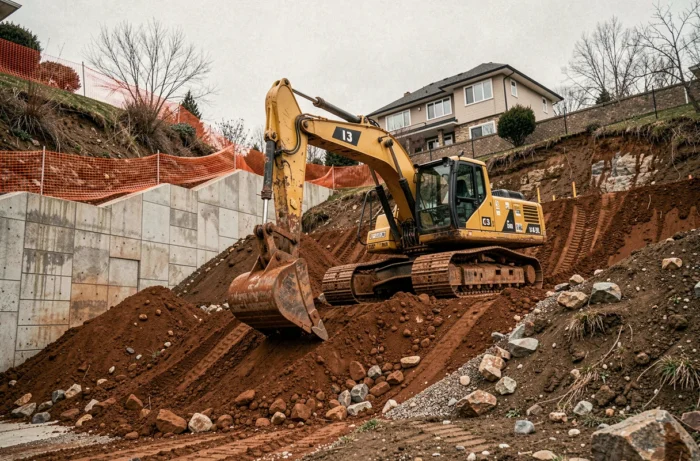
Clay soil is easily moved with a mechanical shovel, but it poses stability issues in case of rain. Rocky soil requires a hydraulic breaker, and sometimes even blasting, which multiplies the time on site and the cost per cubic meter.
According to data from competitors in the sector, earthmoving on rocky soil can reach 50 to 90 euros per square meter excluding taxes, compared to 25 to 40 euros for loose soil on flat terrain. The slope adds an additional layer of difficulty to each scenario.
Site Access on Sloped Terrain
A 20-ton excavator cannot climb a two-meter-wide forest path. When access is complicated, the earthmover must use more compact, less productive equipment, or create a temporary track. This item, rarely detailed in online quotes, can represent several thousand euros on its own.
- Minimum access width for a standard excavator: ensure that the path allows the passage of a dump truck and a tracked machine without excessive detours.
- Slope of the access path itself: beyond a certain incline, a truck loaded with earth cannot safely ascend, necessitating shuttles or temporary on-site storage.
- Distance between the site and the landfill or reuse site for the earth: the removal of excess earth is charged per cubic meter, and the price increases with transport distance.
Overall Additional Cost of Construction on Sloped Terrain
Earthmoving is only the visible part of the budget. A documented field report from 2026 by a professional in the sector details that the slope leads to an overall additional cost often ranging between 20,000 and 80,000 euros once all items are added up.
Special Foundations and Retaining Walls
On a marked slope, classic strip foundations are not sufficient. The engineering office may prescribe beams, piles, or isolated footings suitable for the elevation change. Each solution has its own cost that adds to the pure earthmoving.
Retaining walls (reinforced concrete, rock fill, gabions) hold back the earth upstream of the construction. Their sizing directly depends on the height of earth to be retained and the pressure exerted by the soil. Rock fill can cost between 150 and 250 euros per cubic meter according to available data.
Drainage and Stormwater Management
Water flows down. On sloped terrain, rainwater naturally converges towards the low point, often towards the future construction. A peripheral drainage system (agricultural drain, inspection chambers, outlet) is rarely optional.
In certain configurations, a lifting pump becomes necessary to evacuate wastewater to the municipal network located below. This item, often discovered late in the process, adds installation costs and recurring maintenance costs.
Soil Study and Quotes: The Steps Before Signing
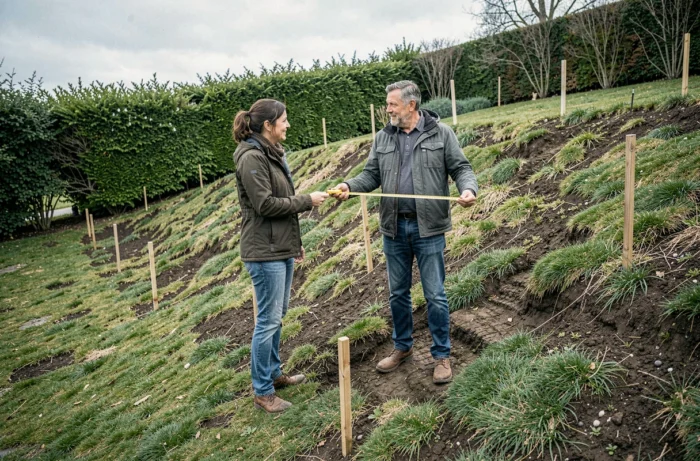
Conducting a geotechnical soil study (G2 study in the pre-project phase) is not a luxury on sloped terrain. It identifies the bearing capacity of the soil, the risks of sliding, and the potential presence of groundwater. Without this study, the earthmover works blindly, and the risk of unexpected additional costs increases significantly.
For the quotes themselves, request at least three, specifying the exact nature of the project. Ensure that each quote separately details the following items:
- The stripping of topsoil and its potential storage for reuse.
- The volume of excavated and backfilled earth, with the cost of removing excess earth per cubic meter.
- The creation of the platform or levels, including compaction.
- The retaining and drainage works if they are included in the service.
A quote that displays a total price without itemization does not allow for comparison. Demand a detailed line-by-line breakdown to identify discrepancies between companies.
Sloped terrain is not necessarily a bad choice: it often offers a lower purchase price and unobstructed views. However, the earthmoving and construction budget must integrate all technical items related to the elevation change from the outset, or risk exceeding the initial envelope by several tens of thousands of euros.