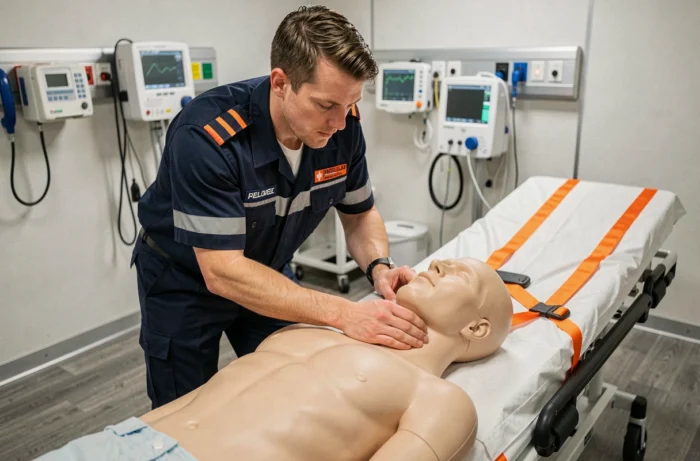
Belgium does not issue a state diploma for paramedics in the French sense of the term. Two distinct certificates structure the profession: the Emergency Medical Assistance (EMA) certificate and the Medical Transport (MT) certificate. A fully qualified paramedic holds both, but each certificate grants different privileges depending on the region of practice.
EMA Accreditation 2024-2026: What the royal decree changes for paramedics
The royal decree of July 4, 2024, amended by that of July 24, 2026, replaces the old system of agreements with real accreditations for ambulance services active in the 100/112 network. The service must now be organized in a clearly defined, uninhabited area separated from any residential or commercial part.
This reform has a direct impact on training candidates. EMA structures that host trainees must comply with these new infrastructure standards, which mechanically reduces the number of available internship locations in the short term. We observe that training centers are adjusting their agreements to incorporate these requirements.
The increased professionalization of accredited services also translates into heightened expectations regarding technical skills and ongoing training for on-duty paramedics. A candidate entering training today must anticipate a higher level of demand than that which prevailed two years ago.
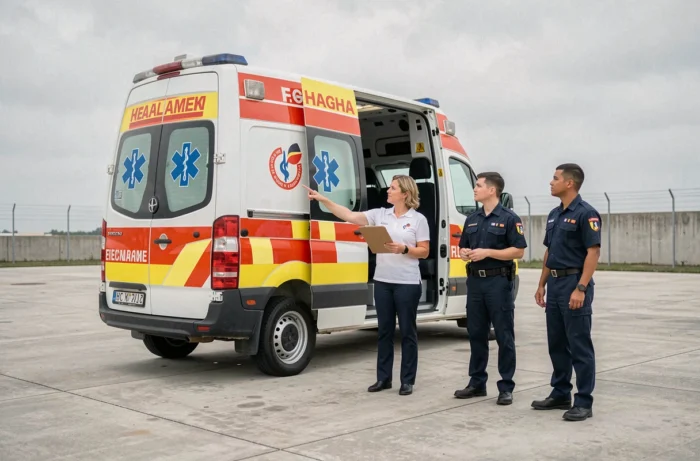
EMA Certificate and MT Certificate: Privileges and Obligations by Region
Understanding the training for paramedics in Belgium requires clearly distinguishing the two certificates and their geographical scope.
- In the Brussels-Capital Region, a simple first aid certificate is legally sufficient to ride in an ambulance, although serious employers require the EMA certificate.
- In Wallonia, both the EMA and MT certificates are mandatory to practice. A candidate without both certificates will not be hired by an accredited service.
- In Flanders, the EMA certificate is the minimum requirement. The MT certificate is strongly recommended for non-urgent patient transport.
This regional disparity often traps candidates who train in one region and wish to practice in another. We recommend systematically aiming for both certificates, regardless of the region of residence.
Admission Conditions and Progression of Paramedic Training
Entry requirements vary by province, but a common foundation applies. The candidate must be presented by an accredited 100/112 ambulance service, be at least 18 years old and no more than 60 years old, provide a criminal record extract, and pay the registration fee.
In the province of Liège, for example, the registration fee is 79.33 euros for candidates presented by an accredited service. External candidates (not presented by a 112 service) must pay a significantly higher amount, corresponding to the subsidy normally allocated by the SPF Public Health, which is 707.23 euros in addition to the registration fee.
Hourly Volume and Educational Methods
The basic training includes a minimum of 160 hours of classes. The theoretical sessions accommodate a maximum of 30 participants, technical workshops are conducted in groups of 10, and practical exercises are held in workshops of 5. This instructor-to-trainee ratio in practice is a quality indicator to check before choosing a center.
Internships complement the curriculum and can extend the total duration to about 180 hours. The availability of accredited internship locations, tightened by the new accreditation standards, is a point to anticipate from the moment of registration.
Exams and Obtaining the Certificate
The evaluation combines theoretical tests and practical simulations. The candidate must demonstrate their ability to manage an emergency intervention independently within their privileges. Nurses holding the SISU title may be eligible for a complete exemption from basic training.

Career Path and Continuing Education for Paramedics in Belgium
The EMA certificate is not a permanent acquisition. A periodic skills reassessment is required to maintain individual accreditation. This continuing education focuses on intervention protocols, technical gestures, and changes in regulations.
The sector has been progressively structuring qualification levels since 2021. The PACT 112 initiative, supported by the Belgambu federation, advocates for stronger professional recognition and a better-defined status for paramedics. The goal is to create clear career paths, with bridges to other health professions.
Rescue zones generally recruit once a year, based on their staffing plan. Job vacancy announcements are published on the zones’ websites and on specialized platforms. A candidate already holding both the EMA and MT certificates, with validated internships in an accredited service, stands out significantly during selection.
The distinction between EMA paramedics and non-urgent patient transport paramedics is expected to be reinforced through regulation. Preparing for both certificates from the start remains the safest strategy to access all opportunities in the sector, whether in a rescue zone, an accredited private service, or a hospital structure.