
A site that takes more than three seconds to load on mobile loses the majority of its visitors before they even read the first word. We regularly see this in audits: well-written pages with relevant content remain invisible because a technical issue blocks everything upstream. Natural referencing starts there, with what the visitor does not see.
Responsiveness measured by INP: the technical criterion that most sites ignore
Since March 2024, Google has replaced FID (First Input Delay) with INP (Interaction to Next Paint) as the official responsiveness metric in Core Web Vitals. The difference is significant: INP measures responsiveness throughout the entire visit, not just on the first interaction.
In practice, this means that a button that takes too long to respond during a session now weighs in the evaluation. A slow contact form, a dropdown menu that hangs, a search filter that freezes the page for a fraction of a second: all of this degrades the score.
To check a site’s status, one can go through the Core Web Vitals report in Search Console or PageSpeed Insights. Frequent causes of a poor INP are third-party JavaScript scripts (chat widgets, stacked tracking pixels, carousels) that block the main thread of the browser. Seeking natural referencing advice focused on performance helps identify these bottlenecks before they harm positioning.
Reducing the number of third-party scripts, deferring their loading, or replacing them with lighter alternatives often results in measurable gains within a few weeks.

SEO Visibility in 2026: beyond the classic Google blue link
Natural referencing is no longer limited to climbing the list of ten blue links. Two recent developments redefine what “being visible on Google” means.
AI Overviews and the end of magic markup
Google confirmed in May 2026 that there is no special markup to appear in AI Overviews. No dedicated schema, no machine-readable file to add. Several providers still sell “GEO” or “AEO” services that supposedly trigger appearance in these boxes, but the official documentation from Google Search Central contradicts this approach.
What works remains what has always worked for editorial content: a clear answer to a specific question, structured content with readable subtitles, and thematic authority built across several pages.
Preferred Sources: a lever for expert sites
Since August 2026, Google’s Preferred Sources feature has expanded to AI surfaces, including AI Overviews and AI Mode. In practical terms, a site identified as a trusted source on a topic can be highlighted in AI-generated responses.
For media and specialized sites, this creates a visibility channel distinct from classic SEO. One no longer optimizes solely for a keyword, but to be recognized as a reference on an entire theme. This involves regular publishing, depth of treatment, and editorial consistency across a defined scope.
Content and internal linking: foundations to maintain continuously
We often audit sites that publish regularly but never touch old articles. Content ages, data becomes outdated, and internal links point to deleted pages. The result: Google eventually considers the site unreliable on these topics.
Three concrete actions change the game when applied methodically:
- Update existing content rather than creating new ones on the same topic. An updated article with recent information often regains visibility within a few weeks, without promotional effort.
- Correct broken internal links and restructure the linking so that each important page is accessible within three clicks maximum from the homepage. Free crawl tools like Screaming Frog (limited version) are sufficient to detect errors.
- Write unique title tags and meta descriptions for each page. We still see sites where the same description is duplicated across dozens of pages, which muddles the signal sent to search engines.
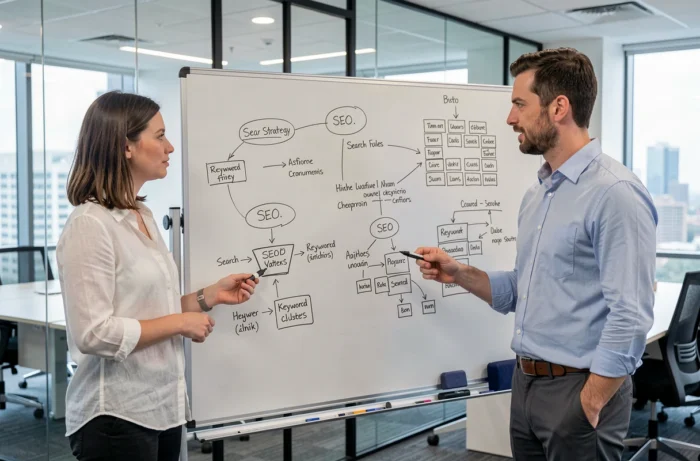
Keyword Research: starting from the question, not the volume
Targeting first the specific questions that customers ask yields better results than aiming for high-volume queries, which are often too broad and saturated with competition.
A heating technician who writes a page on “gas boiler maintenance tenant obligation” reaches a more qualified audience than with “boiler maintenance.” The volume is lower, but the conversion rate is significantly higher on queries with precise intent.
To find these questions, one looks at Google’s suggestions (the search bar and the “People also ask” section), customer reviews (the terms they use spontaneously), and queries that already generate impressions in Search Console without producing clicks. These queries are direct opportunities: the site already appears, often it just takes improving the existing content to move from the bottom of the first page to the top.
Feedback varies on this point depending on the sectors, but the logic remains the same: a relevant keyword is worth more than a popular keyword.
Natural referencing in 2026 requires less cookie-cutter recipes and more attention to concrete signals: technical responsiveness measured by INP, presence in Google’s new AI surfaces, and regularly updated content around precise queries. The sites that progress are those that correct, update, and refine their existing content at a regular pace.