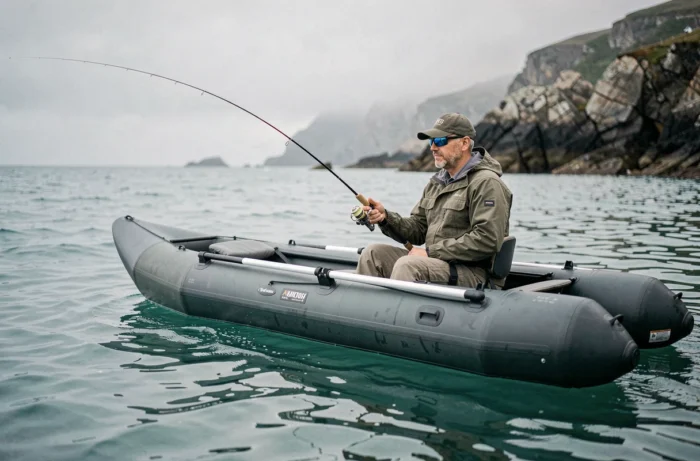
An inflatable canoe used at sea for fishing has little in common with the lake leisure model. The constraints of current, lateral wind, and swell radically change the requirements for materials, shape, and safety equipment.
Since the update of the consolidated Division 240 following the decree of May 21, 2026, French regulations clearly distinguish between beach equipment and vessels suitable for offshore navigation. This point conditions the choice of model even before discussing comfort or rod holders.
Division 240 and regulatory classification: what conditions your navigation range
The regulatory distinction is the first selection filter. An inflatable canoe less than 3.50 m long, or whose manufacturer’s notice does not explicitly mention use at sea, is classified as beach equipment: limited to 300 m from shelter, during the day only. In other words, it is impossible to move away from the shore to reach interesting fishing spots.
To navigate up to 2 nautical miles from a shelter, the manufacturer must guarantee buoyancy and navigation in maritime conditions. This is not just a marketing mention: Division 240, reinforced by the decree of October 11, 2024, requires carrying an individual flotation device (IFD) of at least 50 N per person, with CE marking, verified CO₂ cartridge, and chamber in good condition.
Choosing an inflatable canoe for sea fishing therefore requires checking at the time of purchase that the model is classified as “vessel” and not “beach equipment.” This information is usually found in the manufacturer’s technical documentation. Without it, you remain confined to the 300 m zone, regardless of the price paid.
Stability and course holding at sea: the real technical parameters
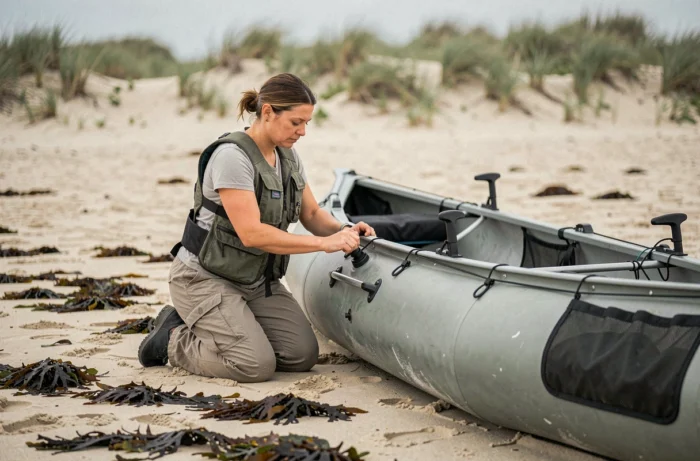
Field feedback converges on one point: stability issues often stem more from under-inflation than from the model itself. An inflatable canoe whose chambers are not at nominal pressure becomes soft, drifts more, and offers an unstable seating position, three disqualifying flaws when handling fishing gear.
Inflation pressure and dropstitch technology
Models with high-pressure floors (dropstitch technology) offer significantly greater rigidity than traditional soft bottoms. This rigidity translates into better performance in choppy water and more efficient gliding. For sea fishing, where lateral stability is as important as forward movement, a dropstitch floor makes a real difference compared to a simple PVC bottom.
Width, length, and load distribution
A wide model provides primary stability, the kind felt immediately when boarding. However, it penalizes speed and course holding in crosswinds. Narrower and longer models hold their trajectory better but require better balance.
The distribution of fishing gear (cooler, tackle boxes, portable sonar) influences as much as the shape of the hull. A poorly centered load causes a permanent list that fatigues the paddler and reduces maneuverability. Here are some concrete criteria to check before purchase:
- The presence of a removable or fixed fin, which significantly improves directional control in current and crosswinds
- An auto-draining system (scuppers or valves) to evacuate onboard water without having to bail during a fishing session
- Sufficient anchoring points to secure gear, cooler, and possibly a rod holder, without compromising paddling space
- A real load capacity taking into account the weight of the fisherman, mandatory safety equipment, and fishing gear
Mandatory safety equipment and practical constraints for the fisherman
The update of Division 240 is not limited to life jackets. Navigating beyond 300 m from a shelter requires carrying a compass and ensuring VHF monitoring. For an inflatable canoe, these obligations raise practical questions: where to secure a portable VHF, how to protect a compass from water, how to remain compliant without turning the vessel into an equipment storage unit.
The flotation vest must be compatible with the seated paddling position and the wearing of a wetsuit. Auto-inflating models with CO₂ cartridges are compact, but their maintenance (checking the cartridge, condition of the chamber) affects their reliability. Foam vests, bulkier, remain functional without special maintenance.
One often overlooked point: the declaration of loan or rental is now mandatory if you lend your vessel to a third party. This reinforcement introduced by the decree of October 11, 2024, also applies to inflatable canoes classified as vessels.
Materials and durability against salt: PVC, reinforced nylon, or Hypalon
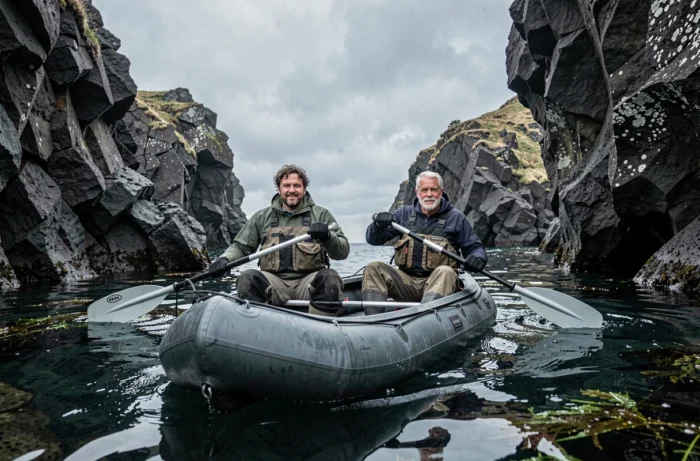
Seawater accelerates material degradation. Standard PVC, common in entry-level models, withstands salt as long as it is rinsed after each outing. Field feedback varies on the actual longevity of these models in regular marine use: some users report premature aging of the seams as early as the second season, while others maintain their vessel for several years without issues.
Coated nylon or Hypalon (synthetic rubber) resist UV and salt better but add weight to the vessel and increase the price. For occasional use (a few outings per month in season), good density PVC, rinsed systematically, may suffice. For intensive use, Hypalon remains the reference in marine environments, despite its higher cost.
The quality of welding and bonding is as important as the material itself. High-frequency welds resist better than cold bonds, especially against repeated inflation-deflation cycles and temperature variations at sea.
Fishing accessories and layout of the inflatable canoe
A model designed for sea fishing incorporates specific fixtures: rod holders, mounting rails for sonar, deck nets to keep lures accessible. On a general-purpose inflatable canoe, these fittings must be added, which requires compatible anchoring points.
Two elements deserve special attention:
- The seat: a high and adjustable seat reduces fatigue during long sessions and facilitates casting. The original inflatable seats are often insufficient for fishing, and replacing them with a clip-on rigid seat significantly improves comfort
- The storage space: the cooler, tackle boxes, and mandatory safety equipment take up considerable volume. A canoe that is too compact forces compromises that harm either comfort or regulatory compliance
Ultimately, the choice of a high-performance inflatable canoe for sea fishing relies less on the brand than on three verifiable parameters: the regulatory classification of the model, the technology of its floor, and its real capacity to carry the fisherman, gear, and safety equipment without sacrificing stability. A model classified as “beach equipment” will never become an offshore fishing vessel, regardless of the equipment added afterward.