
Immediate drying after each wash protects the shine of stainless steel more than the choice of cleaning product. This is the action we recommend as a priority, before any recipe or polish. Most guides focus on the mixtures to apply without addressing what actually degrades the surface on a daily basis: the direction of rubbing, the type of cloth, and the greasy film residues left by certain “tips” on food surfaces.
Greasy films on kitchen stainless steel: shine versus hygiene of food surfaces
Olive oil, beeswax, stainless steel polish: these products leave a hydrophobic film that masks fingerprints and gives a temporary mirror-like appearance. On a staircase railing or a guardrail, there is no problem. On a countertop, a sink, or an all-stainless steel pan, the situation changes.
A greasy film provides a favorable substrate for the attachment of food particles and bacteria. It cannot be rinsed off with clear water. An oily residue on a food surface requires complete degreasing before each use, which negates the supposed time-saving benefit.
We observe that the recommendations from manufacturers of stainless steel countertops converge: for surfaces in direct contact with food, cleaning is limited to soapy hot water, careful rinsing, and drying with a microfiber cloth. Polishes and waxes are reserved for decorative elements (backsplashes, appliance fronts, hoods). Mixing the two protocols compromises health safety for purely cosmetic benefit.
To delve deeper into brushing techniques suited to each finish, you can access the Scoopzilla site which details the actions by type of surface.
Grain direction and brushing stainless steel: the only rule that matters
Brushed stainless steel has a directional grain visible to the naked eye. Rubbing perpendicularly or in circular motions breaks this grain and creates diffuse micro-scratches that dull the surface irreversibly. Polishing the entire face then becomes the only solution to restore an even shine.

Before cleaning, identify the brushing direction by tilting the surface under a low-angle light. The parallel lines indicate the direction to follow. We recommend always using a microfiber cloth folded into quarters, moved in one direction only, without back and forth.
This rule also applies to sponges. A scrubbing sponge (abrasive side) used in circles on a brushed backsplash leaves marks that even a polish will not correct. If you need to insist on a stain, rub in the direction of the grain with moderate pressure rather than increasing the amplitude of the motion.
Dishwasher and stainless steel: why hand washing remains preferable
The dishwasher is technically allowed for most stainless steel utensils. Specialized guides on all-stainless utensils indicate a shift in recommendation: long cycles and powerful detergents promote dulling, stains, and micro-pitting.
Slow drying in the machine exacerbates the problem. Standing water deposits minerals (lime, chlorine) that form whitish stains difficult to remove without white vinegar or citric acid. In contrast, hand washing followed by immediate drying with microfiber or chamois preserves the original shine over time.
- Wash with hot water and a little dish soap, without soaking
- Rinse with clear water to remove all soap residue
- Dry immediately with a clean microfiber cloth, in the direction of the grain if the surface is brushed
- Never let it air dry, especially in hard water areas
This protocol may seem restrictive. In practice, it takes less than a minute per utensil and avoids sessions of descaling or repolishing, which require real effort.
Cleaning stainless steel with white vinegar: dosage and technical limits
White vinegar remains the most effective natural product against limescale deposits and water marks on stainless steel. Diluted in equal parts with warm water, it dissolves mineral veils without attacking the passive chrome layer that protects stainless steel from corrosion.
Concentrated pure vinegar, left on the surface for too long, can alter this passive layer. We advise never exceeding a few minutes of contact time, then rinsing thoroughly. For persistent stains, a paste of baking soda (applied in the direction of the grain) offers a gentle mechanical action as a complement.
- Diluted white vinegar: effective against limescale and marks, rinsing is mandatory
- Baking soda paste: very fine abrasive, suitable for ingrained stains on sinks or cooktops
- Dry flour: used dry on a cloth to polish after cleaning, without greasy residue
These three products cover almost all common situations. Commercial specific stainless steel cleaners often add film-forming agents (silicones, mineral oils) that fall back into the trap of the greasy film mentioned earlier.
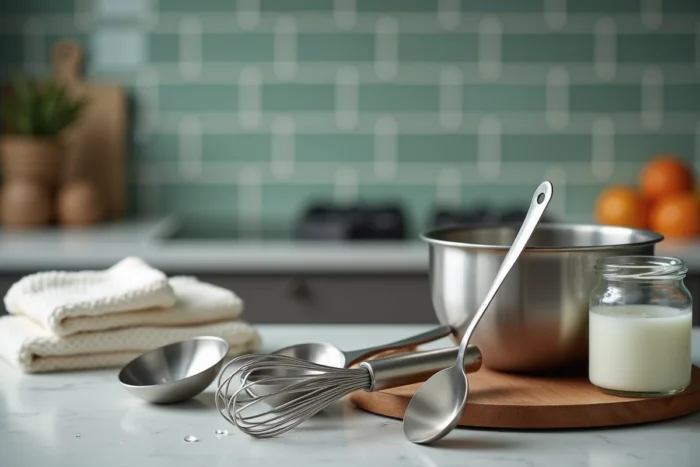
Products and actions to avoid for stainless steel maintenance
Bleach attacks the passive layer of stainless steel and causes corrosion pitting, especially on sinks and faucets that are frequently exposed. Classic scouring powders contain particles that are too coarse, scratching polished and brushed finishes. Steel wool pads should be banned on any stainless steel surface without exception.
Products containing hydrochloric acid, sometimes used for intensive descaling, permanently damage stainless steel. In case of stubborn limescale, hot white vinegar (not boiling) or food-grade citric acid remain the safest options.
Regular maintenance of stainless steel relies on three actions: respecting the grain direction, systematically drying after each contact with water, and reserving fatty substances for surfaces that never touch food. These simple habits maintain shine without compromising hygiene and render most specialized products unnecessary.