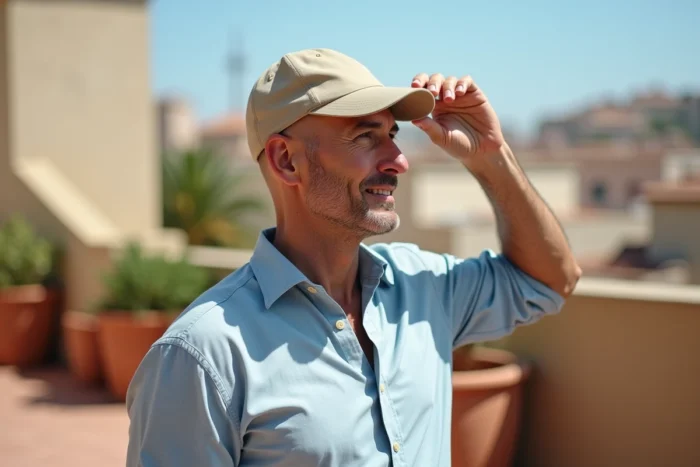
A hairless skull receives UV rays without any natural filter. The exposed scalp continuously absorbs solar radiation, and the warning signals (burning sensation, tingling) arrive later than on the rest of the body. Choosing a cap for a bald head is therefore not just a matter of style: it is primarily a question of skin protection, with technical criteria that most fashion guides overlook.
Fabric Density and UPF Standard: What the Cap Really Blocks
Not all caps filter UVs in the same way. The determining factor, rarely highlighted in mainstream comparisons, is the fabric density. A loosely woven textile, even if opaque in appearance, allows a significant portion of ultraviolet radiation to pass through.
The UPF (Ultraviolet Protection Factor) standard measures the fraction of UV blocked by the fabric. A cap certified UPF 50+ blocks almost all UV-A and UV-B rays. In contrast, a fine cotton cap without certification offers very variable protection, sometimes insufficient for prolonged exposure.
The common trap: relying on color rather than weight. A dark fabric absorbs more heat without guaranteeing better UV filtering if its density remains low. Technical materials (high-density polyester, treated nylon) generally outperform classic cotton in this regard, even in light shades.
To delve deeper into the subject and identify an ideal cap for a bald head, one must look beyond aesthetics and check the manufacturer’s specifications on UV filtering.

Baseball Cap, Wide Brim, or Neck Protector: What Coverage for a Bald Head
The baseball cap remains the most common reflex. It protects the top of the head and partially shades the face. For quick urban use, it does the job.
Its problem on a shaved head: the ears, temples, and neck remain completely exposed. Yet these are areas where the skin is thin and where dermatologists frequently spot sun-related lesions. For a few minutes of exposure, this is not critical. As soon as one spends several hours outdoors, the coverage becomes insufficient.
Caps with Extended Brim and Neck Flap
Some manufacturers offer hybrid models with a longer brim (better covering the nose and cheekbones) and a removable flap for the neck. These caps, often designed for hiking or gardening, provide significantly better coverage than a classic cap.
The compromise is aesthetic: these models do not have the sleek look of a baseball cap. Field feedback varies on this point, between those who prioritize total protection and those who prefer to combine a classic cap with sunscreen on exposed areas.
The Bucket Hat and Wide-Brimmed Hat
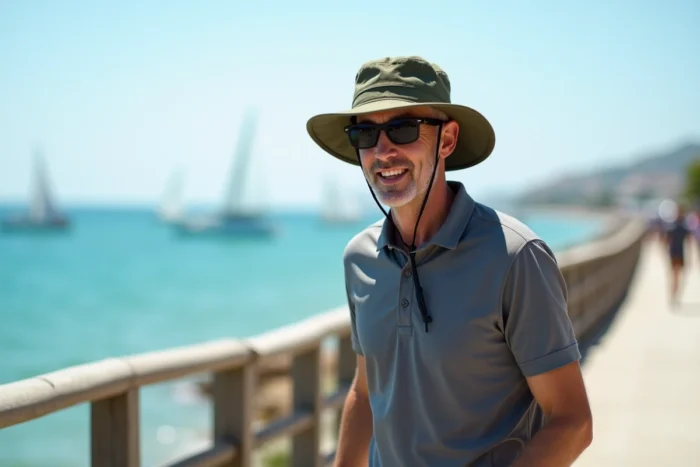
For maximum protection, a wide-brimmed hat covers the entire head, face, ears, and neck. It is the most effective solution from a purely dermatological perspective. The bucket hat, more compact, protects well the head and ears but remains limited for the neck depending on the brim width.
- Baseball cap: protects the top of the head and provides partial shade on the face, but ears and neck are exposed.
- Cap with wide brim and neck protector: extended coverage, suitable for long exposures, more technical appearance.
- Bucket hat or wide-brimmed hat: best overall coverage, suitable for prolonged outdoor activities.
Thermal Comfort on a Shaved Head: Materials and Ventilation
Without hair to absorb sweat, the scalp overheats more quickly under a cap. Thermal comfort becomes a selection criterion as crucial as UV protection.
Synthetic materials with quick-drying properties wick moisture better than cotton. Breathable polyester or mesh nylon, with mesh panels on the sides or back, allow air circulation that limits the “greenhouse effect” under the cap.
Cotton, often perceived as more comfortable, poses two concrete problems on a bald head. It retains moisture, which promotes skin irritation in cases of significant sweating. And once wet, it dries slowly, which maintains an unpleasant sensation.
The Issue of the Inner Lining
Some caps include an absorbent inner band (sponge-type or technical fabric). On a shaved head, this detail changes the experience. An anti-sweat band prevents sweat from running down the face and reduces direct friction between the fabric and the scalp skin.
Models without lining, or with a rigid plastic band, often cause red marks and irritation after a few hours of wear. If you wear a cap daily, the inner finish deserves as much attention as the exterior.
Cap Color and Sun Protection: A Often Misunderstood Link
The common belief is simple: a dark cap protects better from the sun. The reality is more nuanced. The color influences thermal comfort more than UV filtering when the fabric is sufficiently dense.
A white or light fabric reflects some of the solar radiation and accumulates less heat. A black fabric absorbs heat but does not necessarily filter UVs better if the weight is the same. For a bald head exposed for several hours, a light-colored cap made of certified UPF material offers the best compromise between coolness and protection.
- Light colors: less heat accumulation, superior comfort in full sun, equivalent UV protection if the fabric is certified.
- Dark colors: higher thermal absorption, to be reserved for short exposures or intermediate seasons.
- Bright or fluorescent colors: increased visibility for sports activities, variable protection depending on the fabric.
The most relevant combination for a shaved head in summer remains a light-colored cap, made of certified technical material, with ventilation zones. Sunscreen applied to uncovered areas complements the protection, especially on the ears and neck if the cap does not protect them.
Choosing a cap for a bald head comes down to balancing coverage, ventilation, and aesthetics. UPF certification, fabric density, and the presence of an inner band are the three technical criteria that separate a decorative cap from a true sun protection accessory.