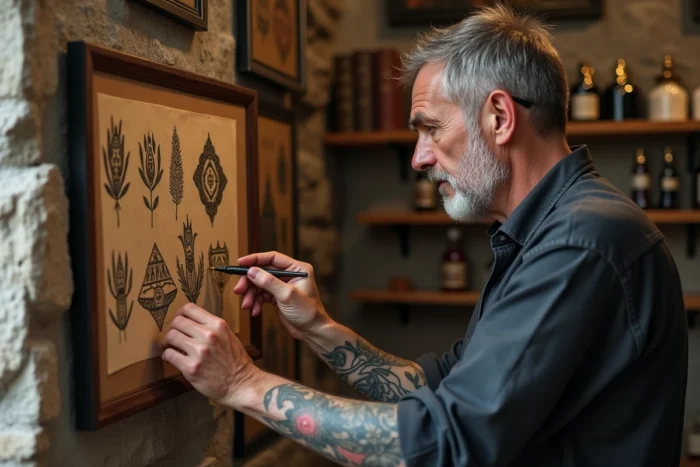
Corse tattoo designs are not limited to an island silhouette etched on a vacationer’s calf. Behind the head of Maure, the wheat ears, or the stylized triton, each line refers to an ancient symbolic register, passed down orally in mountain villages before finding its way onto the skin. Understanding these motifs requires looking beyond aesthetics, towards the social uses and beliefs that shaped them.
Corsican tattoo and dermopigmentation: the same regulatory framework
A rarely discussed point when talking about traditional motifs: the legal framework makes no distinction between a Polynesian tribal tattoo, a photorealistic portrait, and an ancestral Corsican design. Since the decrees of March 5, 2024, and October 11, 2024, any practice of dermopigmentation (including permanent makeup) falls under the same official Hygiene and Sanitation certification, issued by the ARS.
Tattoo artists based in Corsica who perpetuate these motifs are therefore subject to the same obligations as any Parisian studio. Professionals holding old certificates (2008 format) have until March 13, 2027 to pass the certification evaluation. After this deadline, continuing the activity becomes illegal. The certification is valid for five years, with a renewal requiring at least seven hours of training and a multiple-choice questionnaire.
This tightening has a direct consequence on the transmission of traditional know-how: a Corsican artisan tattooing in the old way must today master the same health protocol as a studio equipped with state-of-the-art equipment. Exploring the meaning of Corsican tattoo symbols allows us to measure the gap between the symbolic richness of these motifs and the regulatory standardization that frames their creation.

Head of Maure and agropastoral motifs: origins of Corsican symbols
The head of Maure is the most requested motif, and also the most misunderstood. It is not just a simple flag worn on the skin. Its history is linked to medieval Mediterranean conflicts and the construction of an island identity in the face of invasions. Tattooed, it serves as a marker of belonging that transcends folkloric regionalism.
Vegetal and animal motifs from the pastoral world
The wheat ears, chestnut branches, grape clusters, or silhouettes of mouflons are not decorative choices. They refer to the subsistence economy that structured island life for centuries. The chestnut tree, nicknamed “bread tree” in the villages of Castagniccia, symbolizes the food survival of a mountain population.
- The Corsican mouflon (a muvra) represents wild freedom and resistance, two central values in island culture.
- The wheat ears and fig tree convey the fertility of the land and gratitude towards often ungrateful soil.
- The triton or sea turtle evoke the connection to the Mediterranean, reminding us that the island is as much maritime as it is mountainous.
These agropastoral motifs are often combined within the same tattoo, creating a narrative composition unique to the bearer’s family history.
Oral transmission and absence of archives: the limits of knowledge
The available data do not allow for a certain tracing of the antiquity of certain motifs. Corsica has not produced a written corpus comparable to Maori or Samoan symbol collections. Transmission has been oral, from shepherd to shepherd, from grandmother to granddaughter, without formal codification.
This absence of written archives poses a concrete problem for contemporary tattoo artists seeking to respect tradition. A motif presented as “ancestral” in a studio may actually date back only a few decades, reinterpreted from embroideries or wood engravings whose original context has been lost.
Between authenticity and reinvention
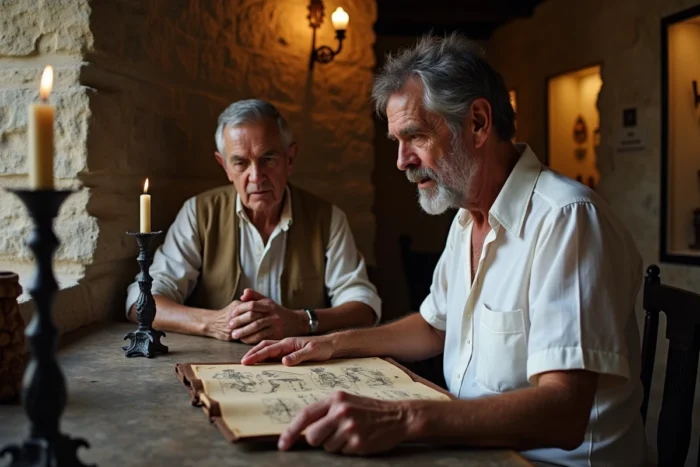
Differentiating a genuinely traditional motif from a recent creation remains difficult. Some Corsican tattoo artists work from ethnographic surveys conducted in regional museums, while others draw inspiration from textile motifs or domestic ironwork. Field feedback varies on this point: what is considered “authentic” differs from one micro-region to another, sometimes from one village to the next.
This fluidity is not necessarily a flaw. It reflects the very nature of an oral culture, where the symbol evolves with its context. However, it complicates the task of anyone seeking a fixed and universal framework for interpretation.
Contemporary Corsican tattoo: what tourists request and what locals wear
The tourist enthusiasm for souvenir tattoos has created a parallel market to Corsican identity tattoos. Tourists mainly request the silhouette of the island, sometimes accompanied by GPS coordinates or a word in the Corsican language. This type of tattoo functions as a bodily postcard, disconnected from the traditional symbolic register.
The Corsicans themselves make different choices. A resident of Cap Corse does not carry the same references as a native of Balagne or Alta Rocca. The chosen motif often refers to a specific place (a peak, a river, a village), a named ancestor, or a family episode. The Corsican tattoo worn by a local tells a genealogy, not a landscape.
This distinction between tourist use and identity use explains why some tattoo artists refuse to reproduce motifs they consider sacred or familial for passing clients. The tension between commercial openness and cultural preservation runs through most studios on the island today.
The Corsican tattoo remains a cultural object in motion, whose deep meaning depends as much on the bearer as on the motif. The symbols do not function like a dictionary where each image has a unique translation. They activate within a context, a lineage, a territory. It is precisely this plasticity that makes their study as rich as it is uncertain.