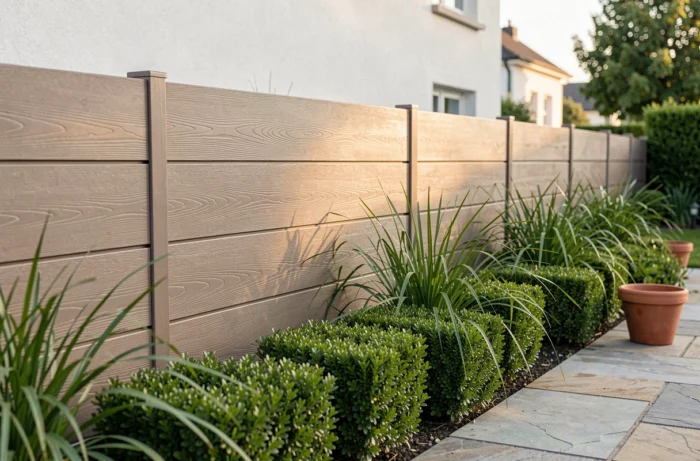
Co-extruded composite has changed the game in the residential fencing market. Where solid wood required a biannual staining cycle and PVC aged poorly under UV, the composite board offers a technical compromise that justifies its initial higher cost. Here we detail the parameters to master before choosing this material for a garden fence.
Co-extrusion and composition of composite boards: what determines longevity
The performance of a composite fence directly depends on its manufacturing process. A mono-extruded board, made of a homogeneous mix of wood fibers and polymer, remains sensitive to stains and moisture absorption on the surface. Co-extrusion adds a protective outer layer that wraps the core on all sides.
This outer shield blocks UV penetration and significantly limits graying. We observe that co-extruded boards retain their original color much longer than mono-extruded boards, even in prolonged south-facing exposures.
The proportion of wood fibers in the core varies by manufacturer. A high wood ratio provides rigidity and a natural appearance but increases sensitivity to moisture if the outer layer is compromised. A higher polymer ratio makes the board more flexible and lighter, at the expense of a wood-like feel. Checking the manufacturer’s technical sheet on this point helps avoid disappointments.
The choice to install a composite garden fence is a higher investment than mono-extrusion, but the difference in durability justifies this gap for any long-term project.
Aluminum posts and anchoring: the weak point that manuals minimize
A well-sized composite fence can be ruined by an inadequate fastening system. The boards withstand the elements, but mechanical stability relies on the posts and their anchoring to the ground.
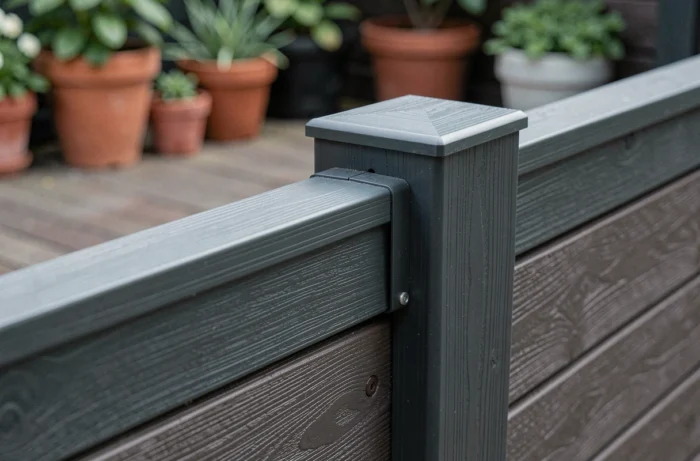
Aluminum posts, often offered in kits with the boards, provide good corrosion resistance. Their section must be calibrated according to the height of the fence and wind exposure. Beyond 1.60 m in height, a concrete anchoring in the ground is preferable to a simple plate screwed onto a slab.
- Direct anchoring in a concrete block of sufficient depth: suitable for soft soils and high fences, it guarantees the best wind resistance.
- Fixing by plate on an existing wall or slab: quicker to implement but limited to configurations where wind exposure remains moderate.
- Anchoring on a wall with a threaded rod and chemical anchoring: a common intermediate solution in renovations, requiring a structurally sound wall.
We recommend checking the compatibility between the section of the aluminum posts and the grooves of the boards. Excessive play between the board and post generates vibrations in strong winds, which over time weaken the fastening clips.
Maintenance of a composite fence: what “zero maintenance” really means
The commercial argument of zero maintenance deserves nuance. The composite requires neither staining, nor painting, nor fungicidal treatment, which radically distinguishes it from natural wood. However, periodic cleaning remains necessary.
Green deposits (algae, moss) appear on any outdoor surface exposed to moisture, including composite. An annual wash with soapy water and a soft brush is sufficient in most cases. The pressure washer should be used with caution: too much pressure can damage the co-extruded layer and open the door to infiltrations.
Scratches are another point of concern. Composite scratches more easily than aluminum or steel. Moving garden furniture against the fence, a misaligned trimming tool, and the mark remains visible. On dark shades like anthracite, these scratches are more noticeable.
Building REP scheme and end-of-life of composite
Since January 2023, construction products, including composite fence boards, are integrated into the Extended Producer Responsibility (REP Building) scheme. Manufacturers and market players must register, pay an eco-contribution, and organize the free collection of sorted waste through approved eco-organisms.
In practical terms, a composite fence installed today enters a structured recycling circuit. During future dismantling, the boards can be directed to collection points dedicated to construction waste, without ending up in landfill. This regulatory framework strengthens the ecological argument for the material, provided the owner informs themselves about the available collection points in their municipality.
However, the mixed wood-polymer composition complicates recycling compared to a mono-component material. Recycling pathways are progressing, but the actual recycling rate of composite remains lower than that of pure aluminum or untreated solid wood. Considering the end-of-life of the product is part of a truly sustainable choice.
Aesthetics and colors: how composite ages in real conditions
Catalogs present uniform shades, from light wood to anthracite gray. In real conditions, co-extruded composite retains its color better than mono-extruded, but a slight lightening over several years remains normal, even in high-end ranges.
The wood-like veined appearance varies significantly from one manufacturer to another. Some finishes replicate a realistic grain, while others remain very plastic to the touch and eye. Requesting a sample before ordering avoids surprises, especially for light shades that reveal texture defects more.
The combination of composite boards and aluminum posts in matching shades (anthracite on anthracite, for example) produces a coherent visual result that integrates well into both contemporary gardens and more classic outdoor settings. This aesthetic versatility partly explains why composite has supplanted solid wood in many residential projects in recent years.
Composite does not suit all budgets or uses. For a low delimiting fence, a wire mesh remains more economical. For high privacy in very windy areas, the robustness of solid aluminum may prove preferable. Composite finds its preferred ground in standard height privacy fences, where the balance between durability, aesthetics, and long-term maintenance cost clearly tips in its favor.