
Rice cooked in the Moulinex Air Fryer presents a problem that most guides overlook: the pulsed hot air dehydrates the surface starch long before the core of the grain has absorbed enough water. Understanding this mechanism radically changes the cooking approach.
Water-rice ratio and grain size: the parameter that the Moulinex Air Fryer does not forgive
In traditional cooking (pot, rice cooker), we tolerate excess water because evaporation remains slow and steady. In an Air Fryer, the high-velocity air circulation accelerates surface evaporation in the mold. The usual ratio of one volume of rice to one and a half volumes of water almost systematically results in a sticky bottom topped with a dry crust.
We recommend starting with a ratio of 1:1.8 for long grain rice (basmati, Thai) and increasing to 1:2 for short grain rice (arborio, sushi rice). The surplus compensates for the loss due to forced evaporation without drowning the grain.
Pre-rinsing plays an amplified role in this context. Three passes under cold water remove the surface starch that would otherwise form a sticky film at the bottom of the mold before the heat reaches the core of the grain. Skipping this step guarantees a mushy result below and crunchy above. For those looking to successfully cook rice in the Moulinex Air Fryer on the first try, this rinsing is the most underestimated variable.
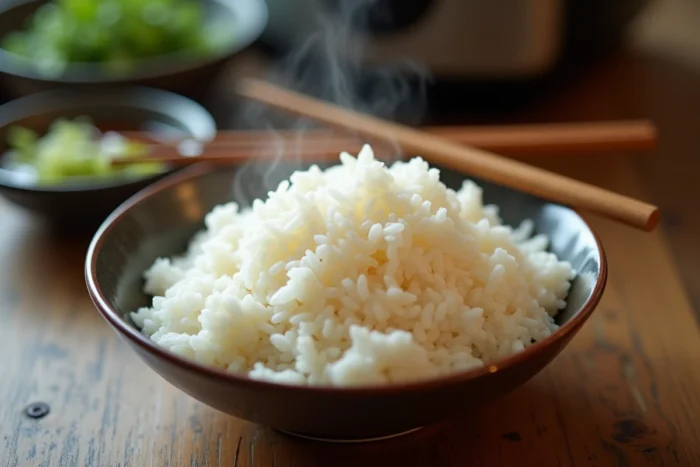
Cooking rice in stages in an Air Fryer: temperature and stirring
The so-called “staged” technique yields the most consistent results. It involves breaking the cooking into short phases with stirring and water adjustments between each step, rather than programming a single cycle.
First stage: temperature rise
Starting at a moderate temperature allows the water to penetrate the grain before the surface sets. We observe that an overly aggressive heat start creates a gelled starch film that blocks internal hydration. Beginning with a gentle stage of a few minutes before increasing the temperature solves this issue.
Second stage: stirring and adding water
After this first cycle, open the basket, gently stir with a silicone spatula, and add a splash of water if the surface looks dry. This action redistributes the moisture trapped at the bottom to the upper layers. The stirring lasts only a few seconds, as the goal is not to break the grains.
Third stage: finalization and resting
Restart cooking at a slightly higher temperature for the final phase. Once the cycle is complete, let the rice rest for five minutes with the basket closed without opening the appliance. The residual steam finishes hydrating the top grains. Opening too early lets this steam escape and produces uneven rice.
Choosing the mold and the impact of coatings on rice cooking
The standard mesh basket of a Moulinex Air Fryer is not designed to hold liquid. A compatible mold is absolutely necessary, and the choice of material directly influences the result.
- Food-grade silicone molds withstand pulsed heat well and facilitate easy removal, but their low thermal conductivity extends cooking time by several minutes compared to a metal mold.
- Aluminum or stainless steel molds transmit heat faster, reducing total cooking time. However, rice tends to stick more easily if the mold is not lightly oiled or lined with perforated baking paper.
- Molds with traditional non-stick coatings work well, but recent regulations on PFAS-type chemical components are prompting manufacturers to change their materials. Checking the compliance of the coating before repeated food use becomes a relevant precaution, especially for a starchy food that adheres strongly when hot.
Regardless of the mold, do not fill it beyond two-thirds of its capacity. Rice expands, and an overloaded mold prevents air circulation around the container, negating the main advantage of the appliance.

Rice varieties and specific adjustments for the Moulinex Air Fryer
Not all rice reacts the same way to pulsed hot air. Basmati, with its long grain and low sticky starch content (amylopectin), adapts best to this method. It dries on the surface without becoming brittle, and stirring between stages is sufficient to homogenize the cooking.
Thai rice (jasmine) contains more amylopectin. It sticks more quickly to the bottom of the mold and requires light greasing or a layer of baking paper. Short grain risotto rice is the most delicate to master in an Air Fryer: its high gel-forming starch content requires a higher water ratio and shorter stages to avoid a compact mass.
Brown or semi-brown rice requires prior soaking of at least twenty minutes. Its bran coating significantly slows down water absorption, and without soaking, the cooking time in the Air Fryer far exceeds that of a conventional method, making the appliance lose its appeal.
Reliability of the Moulinex Air Fryer: what the customer service data says
The Fnac-Darty 2025 Customer Service Barometer ranks Moulinex as the second most reliable brand in the hot air cooking appliance segment, just behind Seb, with a score of 155/200. Philips follows at 135/200, showing significant improvement. This data matters when using the appliance for moist cooking (rice, legumes) that puts more strain on the seals and internal coating than dry cooking of fries or nuggets.
A device with a degraded bowl seal lets steam escape, which skews all ratio and time settings. For regular use for rice, checking the condition of the seal every few months avoids unpleasant surprises. The overall durability of the Moulinex range in this regard is reassuring, but no appliance is eternal when faced with repeated moisture.