The family bond is not established by a trip to the park on Sunday. It is built on regular micro-interactions, asymmetrical rituals tailored to each generation, and a communication architecture that takes into account the actual capabilities of each household member.
Multigenerational Family and Digital Divide: Structuring the Bond Despite Asymmetry
A family that is geographically dispersed or composed of members who are distant from digital technology cannot function with a single WhatsApp group. We observe that the majority of attempts at family coordination fail because they impose a single channel on very different profiles.
The most robust strategy relies on a multi-tiered communication system. Members comfortable with digital technology use a shared discussion thread for logistical coordination (shopping, medical appointments, events). Elders or less connected individuals receive voice notes or short video calls, formats that require less manipulation than written messaging.
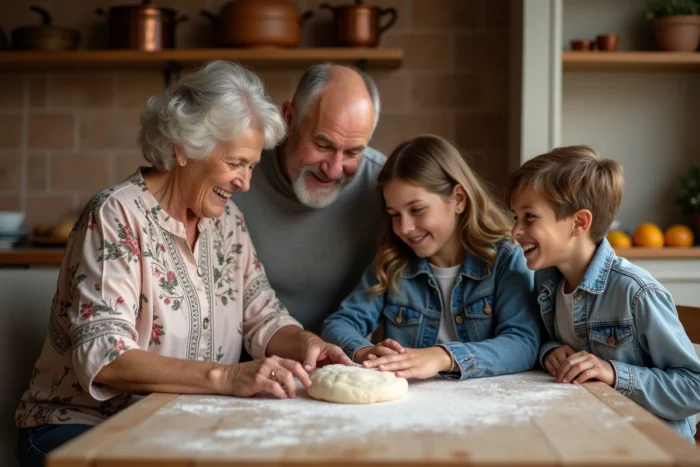
Including grandparents also involves concrete adjustments: increasing the font size on their phone, setting up call shortcuts, pinning frequent contacts. These often overlooked technical adjustments reduce friction and allow elders to stay in the loop without depending on an intermediary. To discover family on Bridge News, several resources address these relational dynamics from a practical perspective.
Social media, when used as coordination tools rather than just for sharing memories, can also serve as a bridge between generations. A shared photo album where everyone uploads an image each week creates a family narrative thread accessible to all, including members who do not participate in group conversations.
Daily Family Rituals: Short Frequency Rather Than Big Events
Research on family cohesion converges on one point: regularity outweighs intensity. A shared meal three evenings a week strengthens the sense of belonging more than an annual trip, no matter how memorable it is.
The most underrated ritual remains the open question at dinner. Asking “what surprised you today?” rather than “how was your day?” changes the quality of the exchange. The first formulation invites reflection, while the second elicits a terse “fine.”
Adapting the Ritual to the Age of the Children
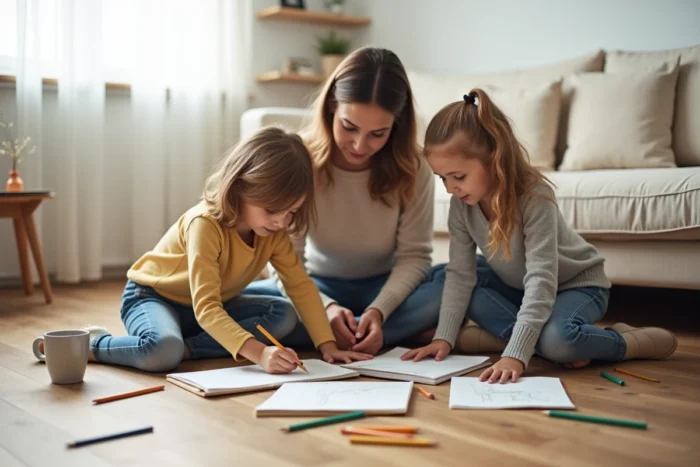
With young children, the ritual benefits from being sensory: preparing a recipe together, gardening, building something with hands. Shared physical activity, even modest, simultaneously impacts mental health and the quality of the bond, as highlighted by the Ministry of Health’s recommendations regarding activity guidelines for parents and children.
For teenagers, we recommend rituals that respect their need for autonomy. A fixed weekly slot (Saturday breakfast, Sunday walk) works better than a daily injunction to “spend time together.” The teenager should be able to anticipate the moment without feeling forced.
Open Communication in the Family: Going Beyond the Emotional Register
Most advice on family communication is limited to “listen to your children” or “express your emotions.” This is insufficient. Strong family communication relies on three distinct registers:
- The logistical register: who does what, when, how. Clarifying this register avoids most domestic tensions related to mental load.
- The emotional register: sharing what one feels, validating the emotions of others. This register only works if the logistical register is already stabilized.
- The projective register: talking about what one wishes, what one envisions, individual and collective projects. This register builds a common vision and gives meaning to daily life.
Separating these three registers in time avoids short circuits: one does not resolve an organizational problem during an emotional sharing moment. Families that function well naturally alternate between these modes without mixing them.
The Case of Blended Families
In a blended family, the logistical register becomes even more central. Children navigate between two households, two sets of rules, sometimes two different communication tools. Setting an explicit framework (shared calendar visible to all, common rules displayed) reduces anxiety related to transitions.

Family Activities That Truly Strengthen Bonds: The Cooperation Criterion
Not all shared activities are equal. Watching a movie together is enjoyable, but cooperative activities create a more lasting bond than parallel activities. The difference lies in interdependence: cooking a recipe together requires coordination, negotiation, and real-time adjustments.
DIY projects, gardening, cooperative board games, or preparing a meal for loved ones mobilize relational skills that mere co-presence does not engage. For families with young children, simple DIY projects (building a fort, painting a piece of furniture) provide a concrete ground for mutual learning.
Shared physical activity deserves special mention. Walking, biking, or swimming together requires neither expensive equipment nor complex organization. Movement frees up conversation: many parents find that their children confide more easily while walking side by side than sitting face to face.
Support for Parenting: Mobilizing Existing Resources
Recent public policies place greater emphasis on supporting parenting and family skills. Local initiatives (family centers, support groups, parent-child workshops) exist in most municipalities but remain little known to families who would benefit most from them.
Seeking these resources is not an admission of weakness. It is acknowledging that the family bond is worked on with appropriate tools, not just with good intentions. Co-parenting workshops, especially after a separation, provide concrete frameworks for maintaining educational consistency between two households.
Strengthening family bonds does not rely on a significant budget or spectacular activities. It depends on the regularity of interactions, the quality of communication, and the ability to adapt channels and rituals to each family member, regardless of their age or relationship with digital technology.