Football remains the most practiced sport in France, with a network of clubs covering almost the entire territory. Starting in this sport involves several administrative and sporting steps, some of which have evolved in recent years with the digitization of federal procedures.
The journey of a beginner player, whether a child or an adult, follows a progression guided by the French Football Federation, from obtaining a license to integration into game formats suited to each age group.
Digital FFF License: What the Procedure Requires Before Stepping onto the Field
Before participating in any official training, every player must obtain a license from the FFF. Since the generalization of the online federal platform, this process follows four mandatory and sequential steps: entering personal information, choosing the level of insurance, uploading supporting documents, and then electronically signing the application.
This digital process replaces the old paper forms submitted to the club’s secretariat. The medical certificate, long seen as a barrier, has seen its requirements evolve according to age categories. For a child discovering football, parents manage the entire procedure from their personal space, which reduces registration delays.
Understanding how to play football with France Sports helps navigate the initial steps and identify the club suited to one’s level, whether one is six years old or thirty.
Feedback from the field varies on this point: some clubs report technical difficulties with the platform at the start of the season when registrations surge. The procedure is standardized, but its execution also depends on the responsiveness of the reference club.
Youth Categories and FFF Game Formats: Regulatory Progression Season by Season
The FFF structures the journey of young players according to age categories that determine the game format, the number of players on the field, and the size of the ball. For the 2026-2027 season, this organization follows a precise scheme.
- U7 and U9: 5-a-side football, size 3 ball. The field is smaller, and matches are short. The goal is to increase ball touches and develop motor skills.
- U11 and U13: 8-a-side football, size 4 ball. The game expands, and concepts of positioning and collective passing emerge. Players begin to occupy identified positions.
- U15 and U17: 11-a-side football, size 5 ball. The adult format is reached. Tactical and physical demands increase, and departmental then regional competitions structure the season.
This progression is not trivial. It conditions how a young player learns football: an eight-year-old does not play on the same field or with the same ball as a fifteen-year-old. The transition from one format to another constitutes a technical step where some players drop out due to a lack of appropriate support.
Why the 5-a-side Format Changes the Game for Beginners
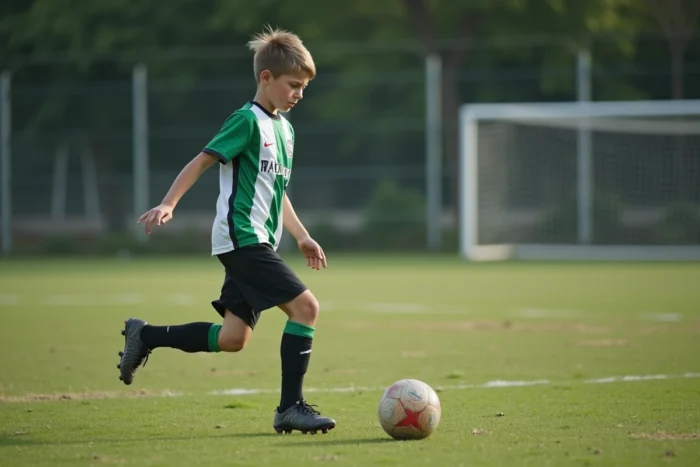
5-a-side football, practiced in U7 and U9, offers a much higher ratio of ball touches per player compared to 11-a-side football. On a small field, every child participates in building the game, defends, attacks, and makes decisions continuously. This format reduces dead time and phases where a player remains a spectator.
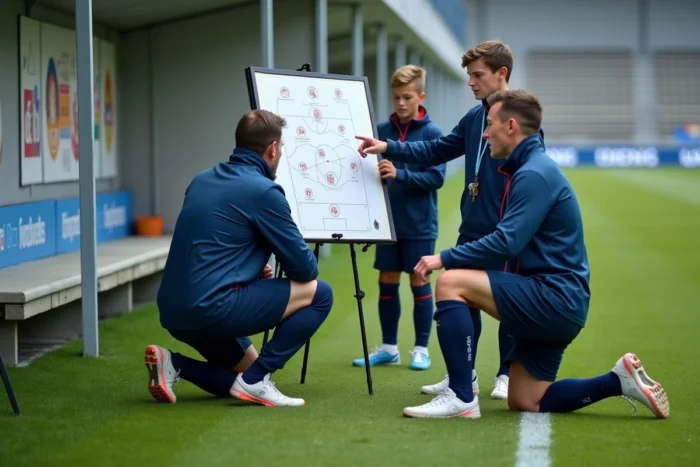
The coaches who oversee these categories hold specific federal diplomas. The FFF mandates training for youth coaches, with modules tailored to the educational challenges of each age group.
Individual Technical Work: Ball Control and Daily Repetition
Improving in football relies on a technical foundation that collective training does not always sufficiently reinforce. Ball control, the quality of the first touch, and passing accuracy are the fundamentals on which a player can work alone, outside of supervised sessions.
Daily repetition of simple actions produces measurable results in a few months. Juggling, passing against a wall, dribbling in a slalom: these exercises require neither a partner nor expensive equipment. They develop foot-ball coordination and technical confidence.
The available data do not allow for a conclusion on an optimal volume of individual training, as it depends on the player’s age, level, and motivation. Training pathways in centers (PSG, Lyon, Rennes) show that individual technical work occupies a significant place in the programs of young residents.
The Role of Mentality in Technical Progression
The mental dimension comes into play from the early years of practice. Accepting the failure of a missed action, maintaining concentration throughout an entire match, managing the pressure of competition: these skills are not acquired through physical repetition alone. Some clubs now integrate mental preparation workshops starting from U13 categories.
A player who technically masters the ball but loses composure in match situations remains limited in their progression. The mental aspect conditions the ability to express one’s technical level under pressure.

Scouting and Football Training Centers: The Selective Filter on the Path to High Level
For players aiming for progression beyond amateur football, the scouting events organized by professional clubs represent a necessary step. These evaluation days, open for registration, allow recruiters to observe players from all over the territory.
The training centers accredited by the FFF are evaluated annually based on sporting, academic, and coaching criteria. The annual ranking published by the federation distinguishes the most effective structures, taking into account both the quality of academic support and sporting results.
Accessing a training center does not guarantee a professional career. The vast majority of young trainees will never sign a professional contract. This statistical reality deserves to be clearly stated, as it conditions how a young player and their family should view this pathway: as a comprehensive training, not as a promise of employment.
The academic journey remains a safety net that the training centers themselves encourage. Sports sections in middle and high school allow for the combination of intensive training and continued studies, a configuration that most professional structures require from their residents.
Football in France offers a structured framework to start and progress, from the small field in U7 to the doors of training centers. The quality of this journey depends as much on individual choices (technical work, mental commitment) as on the support provided by clubs and the federation. Each step, from the digital license to the transition from 5-a-side football to 11-a-side football, constitutes a stage where progression hinges on the details.