Fruit alcohol sold in supermarkets serves as a preservative by creating an environment where microorganisms cannot thrive. Its effectiveness in a jar depends less on the degree displayed on the label than on the exact nature of the product purchased and the rigor applied at each stage of preparation.
Alcohol content and food use: two concepts not to be confused
A high-proof alcohol is not automatically compatible with preserving fruits intended for consumption. The household cleaning aisles in supermarkets offer household alcohol, often denatured by additives that make it toxic if ingested. Only alcohol labeled for food use (fruit maceration, liqueur preparation) is suitable for canning.
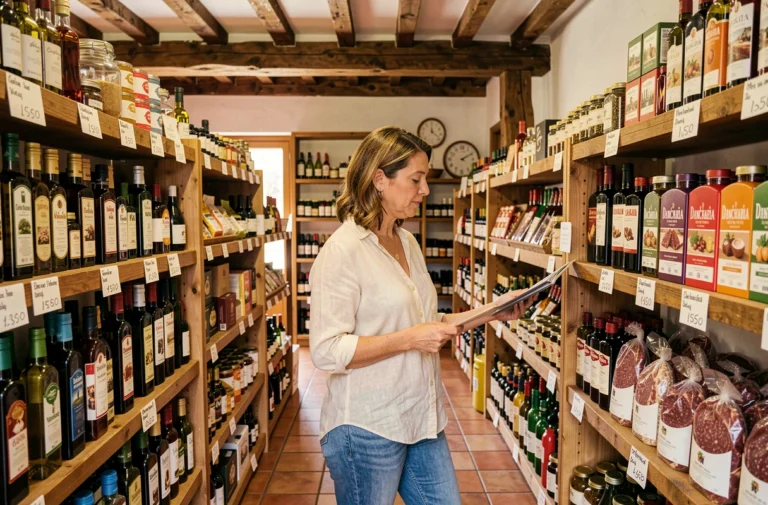
At Leclerc, the appropriate product is usually found in the spirits or gourmet food section, not in the cleaning supplies aisle. The label must explicitly mention food use. In case of doubt, the ingredient list is decisive: denatured alcohol contains added substances (bitrex, methyl ethyl ketone) that have no place in a jar of cherries.
To use Leclerc fruit alcohol under good conditions, it is therefore essential to systematically check the source section and the usage mention on the bottle before any purchase.
Alcohol content and fruit preservation in jars
The alcohol content determines the ability of the alcohol to inhibit bacterial proliferation in the jar. The higher the degree, the more hostile the environment becomes to the microorganisms responsible for fermentation and mold.
A neutral alcohol for fruits generally ranges around 40 to 45 degrees for standard use in brandy. Higher proof alcohols serve as a base that is then diluted with a sugar syrup or water. A degree that is too low does not preserve, while a degree that is too high burns the aromas and alters the texture of the fruits.
Adjusting the degree to the type of fruit
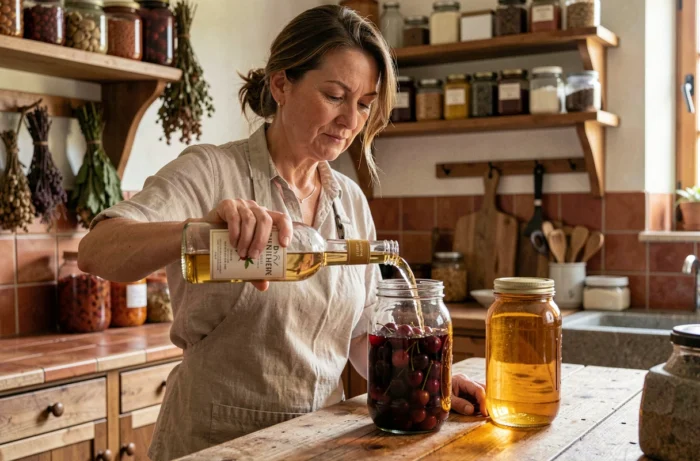
Fruits with firm flesh (pears, quinces) tolerate concentrated alcohol better than soft-fleshed fruits (raspberries, strawberries), which disintegrate quickly in a highly alcoholic environment. For delicate berries, maceration in alcohol brought down to a moderate degree with syrup protects both the texture and flavor.
The basic rule remains simple: fruits must be completely submerged. Any piece exposed to air, even above an alcohol bath, becomes an entry point for oxidation and mold.
The role of sugar as a co-preservative in fruit alcohol
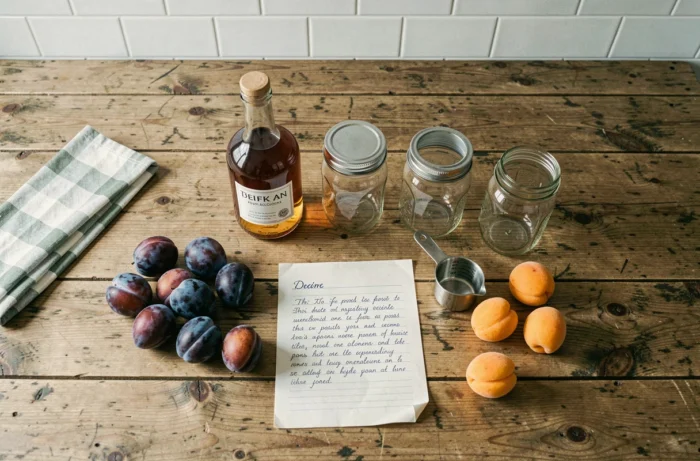
Sugar is not only used to sweeten the preparation. It acts as a co-preservative by lowering the water activity in the jar, which further reduces the bacteria’s ability to multiply. The combination of alcohol and sugar creates a double lock against degradation.
The classic proportion consists of adding sugar for each liter of alcohol used, adjusting according to the natural acidity of the fruit. Citrus fruits and very acidic fruits (lemons, sour cherries) require more sugar to balance the final taste, while naturally sweet fruits (mirabelles, figs) need less.
- Dissolving the sugar in a little hot water before adding it to the alcohol allows for even distribution in the jar, without crystallized deposits at the bottom.
- A syrup that is too light allows the fruits to ferment slowly despite the alcohol, especially if the degree of the latter is moderate.
- An excess of sugar can cause surface crystallization after a few months, which is not a health hazard but has an unappealing appearance.
Hygiene and jars: what alcohol does not correct
Alcohol inhibits microbial growth in the preservation liquid, but it does not sterilize a poorly prepared jar. A worn seal, a twisted lid, or a grease residue on the glass is enough to compromise preservation over several months.
Recent recalls of processed food products in supermarkets, including at Leclerc, remind us that food safety depends as much on controlling the environment (temperature, cleanliness) as on the preservation process itself. An environment reputed to be unfavorable to bacteria does not protect against contamination introduced from the start.
Preparing jars before filling
Before pouring anything into them, each jar and its lid must be boiled and then air-dried, without wiping them with a cloth (a frequent source of bacteria). Rubber seals should be replaced with each new use.
- Check for any chips or cracks on the rim of the jar, even minor ones: a defect invisible to the naked eye can prevent airtight sealing.
- Fill the jar to about one centimeter from the rim to limit the volume of trapped air.
- Store jars away from light and in a cool place: heat accelerates oxidation even in an alcoholic environment.
Maceration time and actual shelf life
Maceration requires a minimum resting period before the flavors of the fruits fully migrate into the alcohol. Opening a jar too early yields a bland liqueur with fruits that still taste raw. Several weeks of patience are necessary for most preparations, and some fruits (green walnuts, sloe berries) benefit from macerating much longer.
The shelf life of a properly prepared jar is measured in years, not months. An airtight jar, filled with sufficient food-grade alcohol and stored in a cool place, remains consumable for a very long time. The main enemy remains the repeated opening of the jar, which introduces air and germs each time.
An opened jar preserves significantly less well than a sealed jar. It is better to prepare several small containers rather than one large jar that is opened regularly. The size of the container, often overlooked, impacts longevity as much as the choice of alcohol itself.