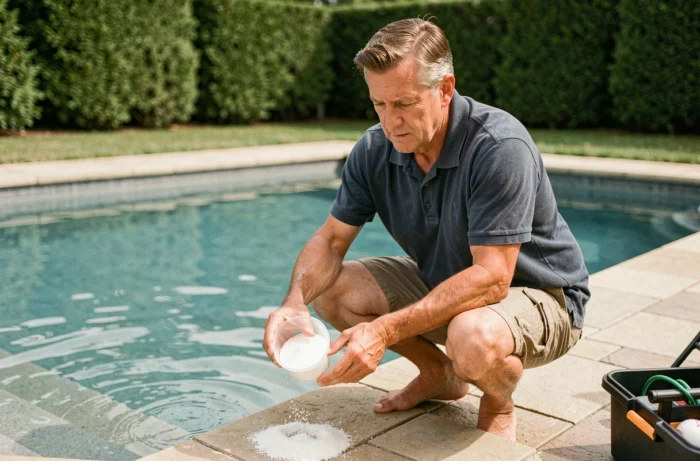
The salt level of a pool is not managed by guesswork. A salinity that is too low reduces chlorine production and accelerates the wear of the electrolysis cell, while an excess causes limescale deposits on the electrodes and can trigger the safety shutdown of the device. We recommend treating salt as a standalone regulatory parameter, just like pH or redox potential.
Control salinity by measuring ORP rather than the raw level
Most guides recommend measuring salinity with strips or an electronic tester, then adjusting. This approach is valid, but it says nothing about the actual disinfection effectiveness at a given moment.
Regulating by ORP (redox) potential adds an extra layer. The ORP signal reflects the oxidizing capacity of the water, thus the effective disinfecting power of the chlorine produced by the electrolyzer. A correct salt level with a low ORP indicates an upstream problem: a scaled cell, too high pH, or insufficient filtration.
The ORP reading is only reliable when filtration is running. A measurement taken with the pump off gives a value distorted by water stratification. We regularly observe discrepancies of several tens of millivolts between a static measurement and a circulating measurement. As detailed in pool salt according to Murmures Déco, understanding the salt-chlorine cycle conditions the entire treatment chain.
In practical terms, if the ORP remains stable and the salinity is within the range specified by the electrolyzer manufacturer, there is nothing to correct. Adding salt “just in case” without prior measurement is the first reflex to eliminate.
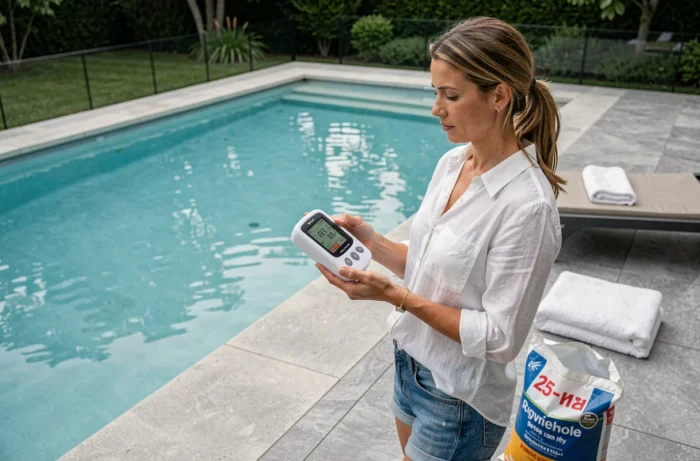
Pool salt: the real causes of salinity loss
Salt does not evaporate with water. Evaporation only concerns water molecules: the salt remains in the pool. This point, often misunderstood, radically changes the frequency of necessary additions.
Salt losses come from three concrete mechanisms:
- Dilution from heavy rainfall or snowmelt, which increases the volume of water without a proportional salt addition. After a prolonged rainy period, salinity can drop significantly.
- Backwashing of the sand filter, which flushes salty water down the drain. Each backwash represents a real loss of salt that must be accounted for in the annual balance.
- Partial drainages, whether voluntary or accidental. Replacing a quarter of the pool’s volume means losing a quarter of the dissolved salt.
Outside of these three situations, salt does not need to be replenished every season. We find that many pool owners add salt in the spring out of habit, without measurement, which pushes salinity beyond the recommended range.
When to add salt to your pool: the practical method
The most logical time to check salinity is during the spring restart, after winterizing. The water may have been diluted by winter rains, and any salt addition should occur before starting the electrolyzer.
Control sequence before the season
Start by running the filtration for a few hours to homogenize the water. Then measure the salinity with a calibrated electronic device. Strips give a rough estimate, but their margin of error is too wide for fine adjustments.
Compare the result to the range indicated in your electrolyzer’s manual. The target concentration is generally between 3 and 7 g/L depending on the models. Do not rely on a generic value found online: each manufacturer calibrates its cells for a specific range.
Dissolving and distributing salt
Pour the salt directly into the pool, preferably in front of the return jets, with filtration running. Use salt that complies with the EN 16401 standard, without anti-caking additives or iodine. Tablet or granular salt dissolves faster than coarse crystal salt, preventing clumps at the bottom of the pool.
Wait at least 24 hours before restarting the electrolyzer. Complete dissolution takes time, and a salinity measurement taken too early does not reflect the actual concentration.
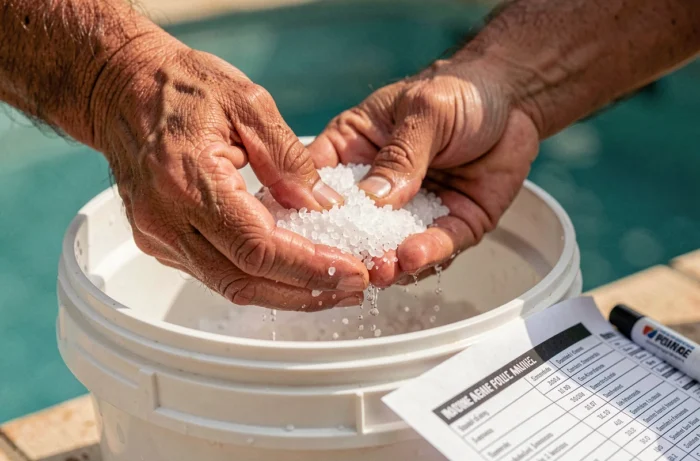
Electrolysis cell: maintenance and winterizing to preserve salinity
The cell is the fragile link in the system. Scaled electrodes reduce chlorine production, leading some users to over-salt the water instead of cleaning the cell.
At the end of the season, we recommend removing the cell, draining it completely, and storing it dry. A visual inspection allows you to spot white limescale deposits on the plates. Soaking in a diluted hydrochloric acid solution (proportion indicated by the manufacturer) is usually sufficient to restore the active surface.
A clean cell maintains chlorine production at constant salinity. Investing a few minutes in maintenance prevents unnecessary salt addition and prolongs the life of the electrodes.
Solar filtration and chlorine production: optimizing timing
UV rays degrade free chlorine. Logic would suggest filtering at night to produce chlorine in reserve. In practice, the opposite works best.
Running filtration during the sunniest hours allows the electrolyzer to produce chlorine when the demand for disinfectant is highest: swimming, heat, UV radiation. The production compensates for degradation in real-time, which maintains a more stable chlorine residual than with nighttime filtration.
This timing also reduces peaks of chloramines in the evening, often responsible for the characteristic smell that is wrongly attributed to the salt itself.
Salt dosing in a pool relies on measurement, not on a calendar. Check salinity after each dilutive event, keep the cell clean, and synchronize filtration with sunlight to make the most of your electrolyzer. Missing salt is measurable; adding it for no reason ends up causing more problems than it solves.