When a dragon crosses the screen or an entire city collapses in seconds, the viewer doesn’t think about the software. Behind these images, VFX artists assemble dozens of visual layers, and their way of working is changing rapidly. The schools that train these profiles must keep up with the movement, sometimes reinventing entire sections of their curriculum. Digital special effects, hybrid pipelines, artificial intelligence: the content of film programs is transforming deeply.
Hybrid AI Pipelines: What VFX Curricula Now Teach
Have you noticed that some special effects shots seem more realistic year after year, even though budgets don’t always increase? Part of the explanation lies in hybrid pipelines. A pipeline is the production chain of a VFX shot: modeling, animation, lighting, compositing. Each step passes from one software to another, from one team to the next.
What is changing today is the arrival of generative AI modules integrated directly into these pipelines. According to Movies Insiders, audiovisual training schools are now incorporating modules on generative AI, data management, and hybrid workflow design. The goal: to train profiles capable of communicating with engineers as well as directors.
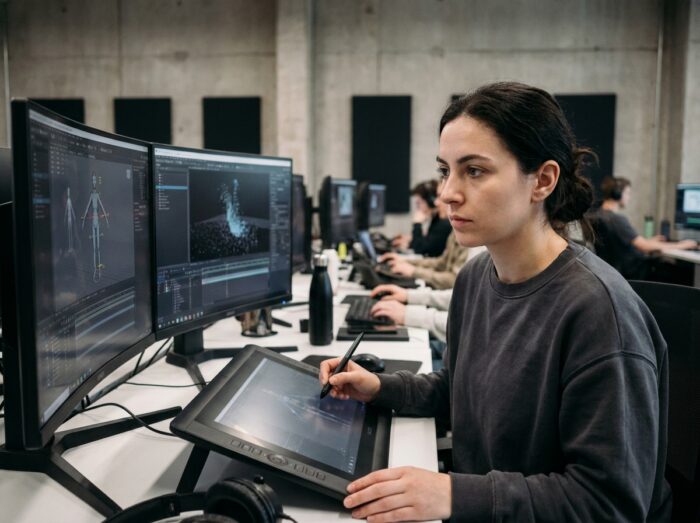
In practical terms, a special effects student no longer just learns rotoscoping frame by frame. They learn to set up an AI tool that will automatically cut out a character, and then to manually correct the result. The technical gesture remains present, but it shifts towards supervision and quality control of the generated result. To better understand how schools are adapting to digital special effects, this reconfiguration of tasks serves as the starting point.
VFX Training and Pipeline Design: From Repetitive Tasks to Supervision
For a long time, the first years in animation or visual effects schools relied on repetitive production exercises. Cutting out elements, cleaning green screens, retouching textures pixel by pixel. These tasks trained the hand and the eye.
The problem is that these execution tasks are the first to be automated by AI. Movies Insiders highlights the reconfiguration of technical jobs in modern pipelines: post-production assistants, rotoscoping, repetitive VFX. Schools that continue to train solely on these gestures are preparing profiles that are already out of sync with the reality of studios.
Curricula that are adjusting now teach pipeline design rather than just the execution of isolated tasks. This means that a student learns to organize the sequence of tools, to choose which software to entrust to AI and which render to keep under human control.
What This Changes in the Classroom
Instead of an exercise where the entire class produces the same shot, some schools offer projects where each student designs their own pipeline to achieve a given visual result. The evaluation focuses on the choice of tools and the quality of the final render, not on the number of hours spent cutting out.
This shift also pushes teachers to engage in continuous training. An instructor specialized in compositing under After Effects must understand how the new AI functions modify their software and convey this understanding to their students.
Generative AI in Film: Teaching Limits as Much as Possibilities
Generative AI fascinates, but it also raises concrete questions that schools must address. A report from Euronews during the largest animation festival in Europe described AI as a “taboo subject,” revealing tensions between technological enthusiasm and professional concerns.
Serious training programs do not just show how to generate an image with a prompt. They also teach:
- The limits of visual coherence of AI-generated images, which always require manual adjustments to fit into a film shot (lighting matches, perspective, image grain)
- Copyright issues related to training datasets, a still unclear legal point that every professional VFX artist must know
- The distinction between algorithmic AI (data analysis, trend prediction) and generative AI (creation of images, textures, movements), two tools with very different uses on set or in post-production
Training a competent VFX artist means teaching them when not to use AI. A shot where an actor interacts with a digital element in close-up requires total human control over textures and micro-expressions. AI can provide a base, but the finishing touches remain artisanal.
Technical and Artistic Skills: The Balance VFX Schools Seek
A common pitfall in digital special effects training is stacking software without solidifying the artistic foundation. A student can master Houdini, Nuke, and Maya without knowing how to compose a readable image or direct the viewer’s gaze.
Schools that produce the most sought-after profiles by studios maintain a substantial volume of fundamental courses:
- Observation drawing and image composition, to understand light and volumes before simulating them digitally
- Analysis of film sequences, to deconstruct how a special effects shot fits into a narrative edit
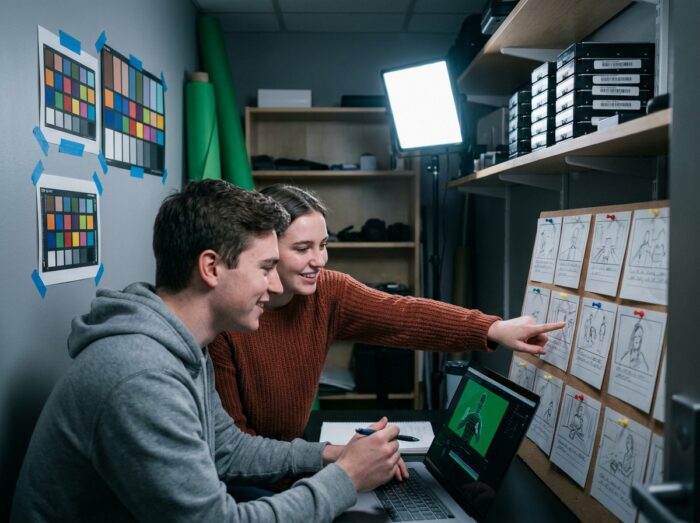
- Teamwork on short projects, replicating the real conditions of a production pipeline with defined roles (VFX supervisor, compositing artist, texture artist)
Technique without visual culture produces spectacular but poorly integrated effects. A digital matte painting course, for example, gains relevance when it builds on the study of traditional cinema set painters, who solved the same problems of perspective and atmosphere with brushes.
Professional Projects and Studio Partnerships
Several programs offer final projects carried out in partnership with production or post-production studios. These collaborations allow students to work on real assets, with deadlines and technical formats identical to those of a professional production. It is in this type of project that the ability to design an appropriate pipeline, rather than execute isolated tasks, makes a difference.
Schools of special effects that truly adjust their curricula do not just add an “AI” module to their brochure. They rethink the articulation between artistic skills, technical mastery, and understanding of new tools. The role of a VFX artist is not disappearing with AI; it is shifting towards supervision and artistic direction. Training that prepares for this shift gives its graduates a competitive edge.